
Shopify can be an excellent ecommerce platform, and a growing business should not replace it simply because revenue or order volume has increased.
The question is whether your ecommerce platform still fits the way your business now sells, prices, fulfils and manages orders.
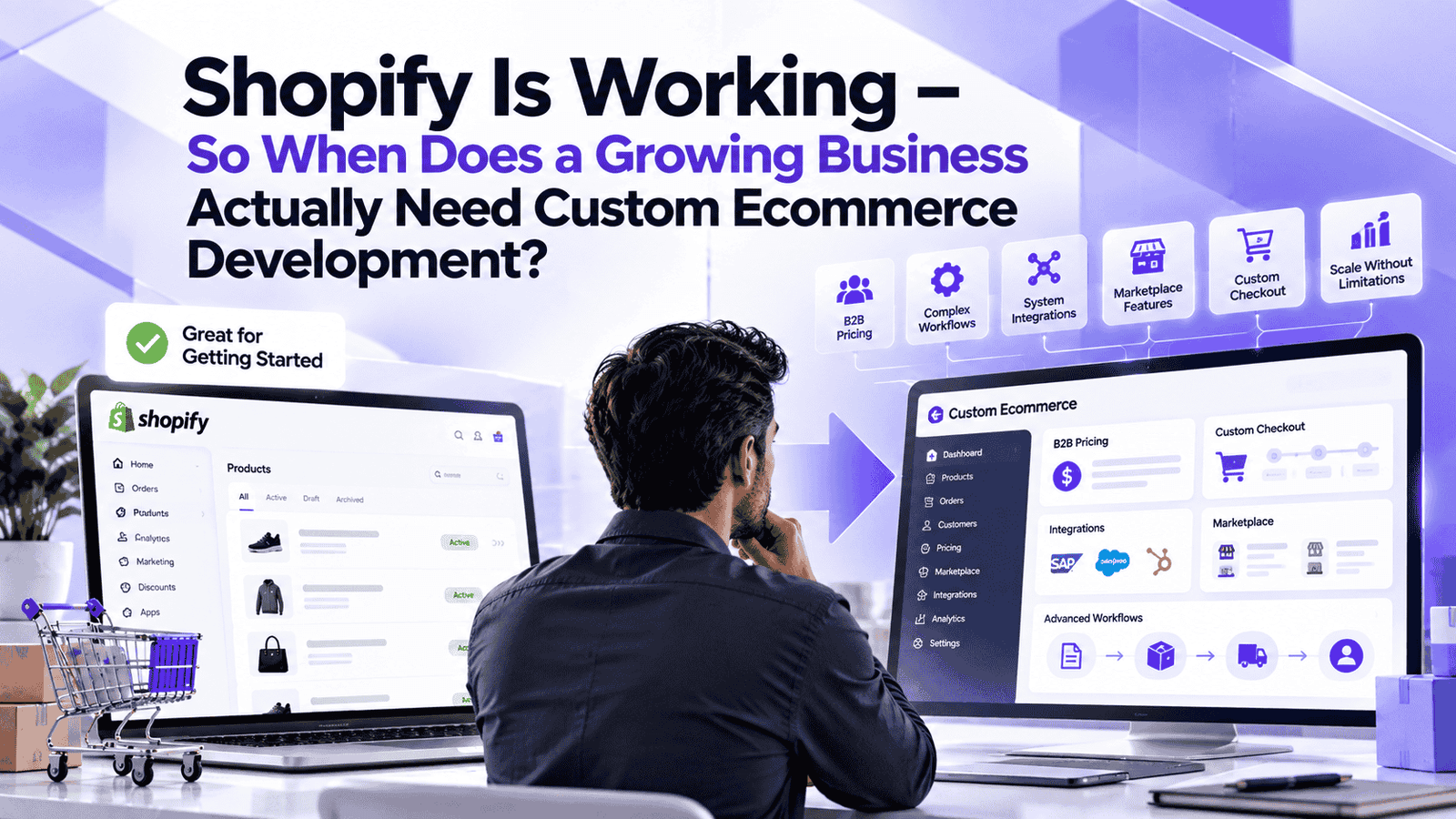
For some businesses, Shopify remains the right foundation with additional configuration, apps or integrations. For others, increasingly complex B2B pricing, workflows, system integrations, marketplace requirements or customer experiences eventually create a case for custom ecommerce development.
Do Not Replace Shopify Just Because Your Business Is Growing
Growth alone is not a reason to build a custom ecommerce platform.
If Shopify supports your customer experience, operational workflows and integrations without excessive workarounds, keeping it may be the better commercial decision.
Custom development becomes worth evaluating when the business repeatedly changes its processes to fit the platform rather than technology supporting how the business actually needs to operate.
The important question is not:
“Have we outgrown Shopify?”
It is:
“Are our ecommerce requirements becoming expensive or difficult to deliver within our current architecture?”
1. Your B2B Pricing Is Becoming More Complex
B2B ecommerce can require significantly different buying rules from a standard consumer store.
Different customers may need different catalogs, negotiated pricing, volume rules, payment terms, purchasing permissions or approval processes.
Shopify provides native B2B capabilities, with feature availability varying by plan. However, businesses with highly specialized pricing or purchasing logic may still need additional customization or integrations.
The point where custom development becomes relevant is when your commercial rules are difficult to represent cleanly within the available platform architecture.
2. Your Ecommerce Workflows Depend on Manual Workarounds
A growing ecommerce operation may involve more than accepting an order and shipping a product.
Orders might require approval, quotation, configuration, stock validation, warehouse routing, credit checks or other business-specific steps.
If employees constantly export spreadsheets, copy information between systems or manually correct orders because the ecommerce platform does not match the operational workflow, the problem is no longer only ecommerce design.
It is a systems problem.
Custom development can connect the buying journey with the processes that happen after the customer clicks Buy.
3. Too Many Apps Are Holding the Store Together
Apps can be one of Shopify's strengths.
They allow businesses to add capabilities without building everything from scratch.
But there is a point where a store can accumulate overlapping applications for pricing, subscriptions, search, loyalty, B2B, fulfilment, personalization and integrations.
The problem is not the number of apps alone.
The warning sign is when the business experiences duplicated functionality, conflicting data, performance issues, difficult maintenance or several subscriptions solving parts of one core workflow.
At that stage, compare the cost and complexity of the current stack with a more purpose-built solution.
4. Your ERP, CRM or Warehouse Integration Is Becoming Critical
As ecommerce grows, the online store often becomes one part of a larger technology ecosystem.
Orders and customer information may need to move between:
Ecommerce → ERP → Inventory → Warehouse → CRM → Accounting → Customer Communication
If these systems are poorly connected, employees become the integration layer.
They manually update stock, transfer customer data, reconcile orders or correct information between platforms.
Custom ecommerce development and systems integration can become valuable when reliable data movement between business systems is essential to daily operations.
5. Your Business Needs Highly Specialized Checkout Logic
Checkout requirements can become more sophisticated as the business model evolves.
A company may need purchasing rules based on customer type, products, order value, payment conditions or other business logic.
Shopify provides checkout extensibility and backend customization capabilities, with some advanced functionality dependent on the merchant's plan and implementation.
The decision for custom development should therefore be based on the specific requirement, not the assumption that Shopify checkout cannot be customized.
If the required purchasing process still cannot be delivered appropriately within the platform's supported architecture, a more customized solution may deserve consideration.
6. You Are Building a Marketplace, Not Just a Store
A conventional ecommerce store sells products from one business to customers.
A marketplace introduces another layer.
You may need seller onboarding, vendor dashboards, commissions, product approval, split workflows, marketplace reporting, seller payouts or different permissions for multiple parties.
Some marketplace models can be built using existing platforms and applications.
Others become sufficiently specialized that custom ecommerce architecture provides greater control over the underlying business model.
The decision depends on how central marketplace functionality is to the business.
7. Customers Need Their Own Portals and Workflows
Some businesses need much more than product browsing and checkout.
Customers may need to log in and manage:
- Company-specific products and pricing
- Previous orders
- Reordering
- Quotations
- Documents
- Multiple users
- Account permissions
- Service requests
At this point, the ecommerce experience begins to overlap with a customer portal or business application.
A custom web application may sometimes sit alongside Shopify rather than replace it.
This is why the correct decision is not always Shopify versus custom ecommerce.
A hybrid architecture can sometimes preserve Shopify where it works while custom development handles the workflows it was not intended to manage.
8. Your Product Configuration Is Highly Complex
Some products cannot be sold effectively through a simple variant selector.
The final product may depend on dimensions, components, compatibility, customer inputs, configuration rules or dynamically calculated options.
If the purchasing experience requires complex logic before an order can be created, a standard product page may become restrictive.
Custom development can create a buying interface around the actual configuration process while connecting the final order with relevant backend systems.
9. International Operations Require More Business-Specific Logic
Selling internationally can introduce multiple currencies, markets, languages, taxes, duties, catalogs, inventory locations and fulfilment rules.
Shopify already provides substantial international commerce capabilities, so international growth by itself does not justify custom development.
The issue arises when your specific international operating model requires rules or integrations that the existing setup cannot support efficiently.
Before rebuilding anything, identify the exact limitation and determine whether configuration, an app, Shopify Plus, an integration or custom architecture is the most appropriate response.
10. Your Team Is Building the Business Around Platform Limitations
This is one of the strongest warning signs.
Employees may say:
“We cannot sell it that way because the website cannot handle it.”
“We have to enter those orders manually.”
“That customer pricing lives in another spreadsheet.”
“We cannot connect those systems.”
“We need three applications to complete that process.”
When technology repeatedly dictates how the business must operate, calculate the commercial cost of those constraints.
The answer may still be improving the existing Shopify implementation.
But it is also the right time to evaluate alternatives.
Custom Ecommerce Does Not Always Mean Replacing Shopify
This distinction matters.
There are several possible paths:
Keep Shopify as it is when it already meets the business requirements.
Extend Shopify when custom applications, integrations or frontend development can solve the problem.
Use a hybrid architecture when Shopify should continue handling core commerce while custom software manages specialized portals, workflows or integrations.
Build a more customized ecommerce platform when the business model requires control that cannot be delivered efficiently within the existing architecture.
The objective should be to choose the simplest architecture capable of supporting the business properly.
Calculate the Cost of Complexity Before Rebuilding
Custom software creates flexibility, but flexibility comes with responsibility.
A custom ecommerce system may require greater investment in development, testing, hosting, security, maintenance, integrations and ongoing technical support.
That means the business case should not be based on frustration alone.
Compare the cost of your current limitations against the cost of solving them.
Consider manual staff hours, app costs, lost sales opportunities, integration problems, maintenance, customer friction and the strategic value of capabilities the business currently cannot provide.
Only then can you determine whether custom development is commercially justified.
Final Takeaway
If Shopify is working, there is no reason to replace it simply because your company is growing.
The case for custom ecommerce development becomes stronger when your business model requires specialized B2B pricing, complex operational workflows, deep system integrations, marketplace functionality, customer portals, advanced product configuration or other requirements that are becoming difficult to support efficiently.
Even then, a complete rebuild is not automatically the answer.
The right solution could be a better Shopify implementation, custom integrations, a hybrid architecture or a purpose-built ecommerce platform.
At Oxmite, we evaluate the business requirements first and the technology second. The objective is to determine what should remain on your existing platform, what should be integrated and where custom development could create genuine commercial value.
Before investing in a rebuild, find out whether your business actually needs one.
Assess Whether Custom Ecommerce Is Worth It and identify the most appropriate architecture for your ecommerce requirements, integrations and future growth.