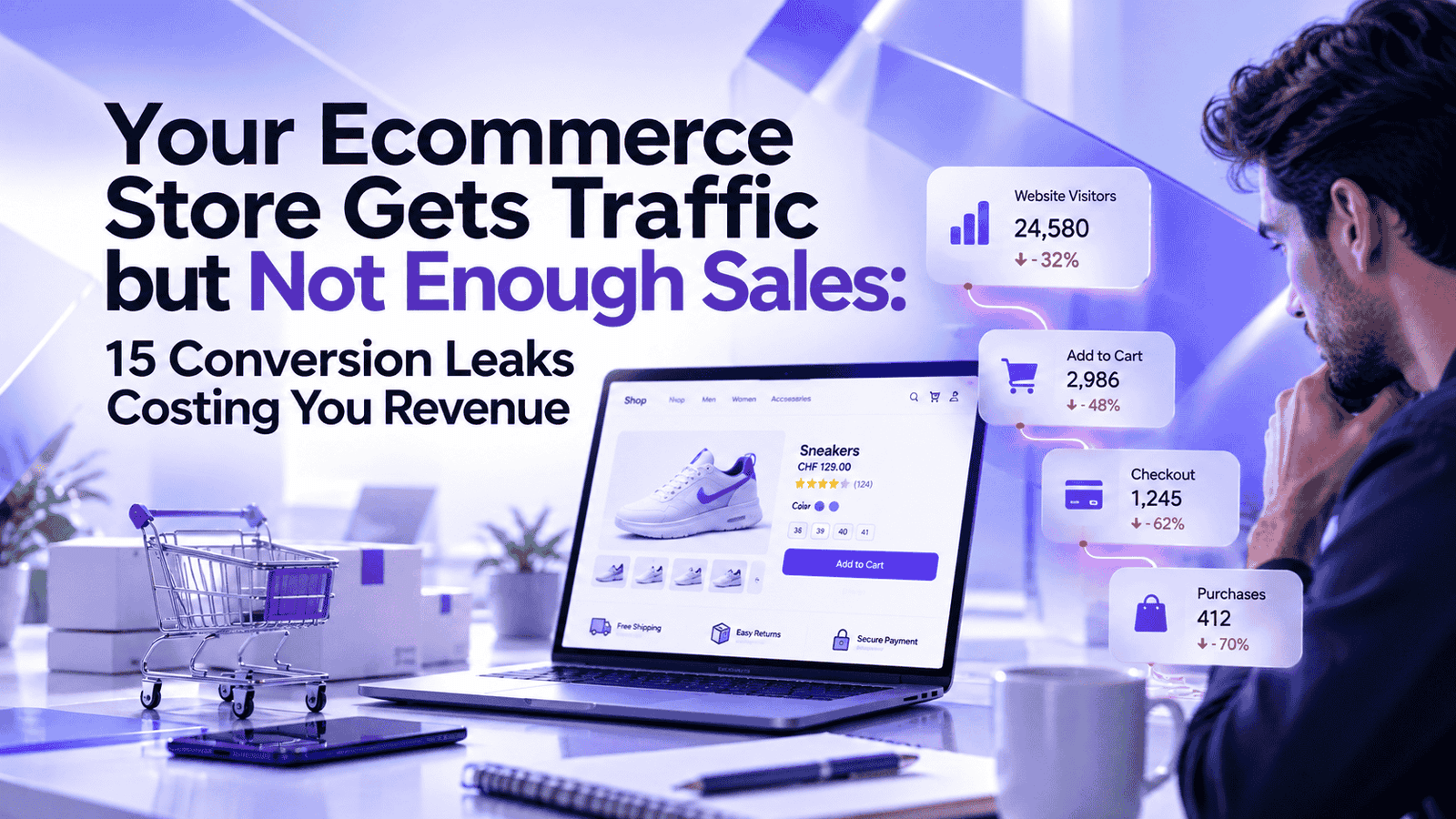
Getting more traffic will not solve an ecommerce store that struggles to convert the visitors it already has.
If people arrive from Google, social media, paid advertising or email but leave without buying, the problem may be inside the shopping journey. Product pages, mobile usability, site speed, search, trust, checkout and follow-up can all create small points of friction that quietly reduce sales.
Effective ecommerce conversion optimization starts by finding these leaks before spending more money acquiring additional traffic.
1. Your Product Pages Do Not Answer Buying Questions
A product page needs to do more than show a photo, title and price.
Customers need enough information to decide whether the product is right for them. Unclear specifications, weak descriptions, missing sizing information or unanswered questions create uncertainty.
Better product content reduces that uncertainty and gives shoppers more confidence to continue toward checkout.
2. Product Photography Does Not Build Confidence
Online customers cannot physically inspect a product.
Images therefore carry much of the responsibility for communicating quality, size, detail and context.
High-quality photography, useful angles, close-ups and appropriate lifestyle images can help customers understand what they are buying.
The objective is not simply making the website attractive. It is reducing the information gap between viewing a product online and evaluating it in person.
3. Your Mobile Experience Creates Friction
A store can look excellent on a desktop and still lose customers on mobile.
Small buttons, crowded navigation, difficult filters, intrusive pop-ups and awkward checkout forms make shopping harder on smaller screens.
Test the entire purchasing journey on a real phone:
Landing page → Category → Product → Cart → Checkout → Payment
If any stage feels unnecessarily difficult, mobile customers may be abandoning before they purchase.
4. Your Website Is Too Slow
Every additional wait creates another opportunity for a shopper to leave.
Large images, excessive scripts, poorly optimized applications and inefficient frontend code can make ecommerce pages feel slow, particularly on mobile connections.
Performance optimization should focus on the pages closest to revenue: category pages, product pages, cart and checkout.
A faster ecommerce website experience supports both usability and conversion instead of forcing customers to wait before they can buy.
5. Customers Cannot Find the Right Product Quickly
More products do not automatically create more sales.
Large catalogs become difficult to shop when search, categories and filtering are weak.
Customers should be able to narrow products using criteria that actually influence their buying decision, such as category, size, compatibility, price, availability or other relevant attributes.
Good ecommerce navigation reduces the distance between customer intent and the right product.
6. Your Calls to Action Are Easy to Miss
The most important action on a product page should not require investigation.
If the Add to Cart or Buy button is visually weak, inconsistently positioned or surrounded by competing actions, customers have to work harder to move forward.
A strong ecommerce interface creates clear visual priority around the next step.
Conversion-focused design is not about adding more buttons. It is about making the correct action obvious.
7. Your Store Does Not Provide Enough Trust
Customers evaluate risk before giving an unfamiliar business their money.
Poor design, unclear company information, missing contact details, confusing policies or an inconsistent checkout experience can weaken confidence.
Relevant trust signals may include clear business information, genuine customer reviews, secure payment experiences and transparent delivery, return and refund information.
Trust should be built throughout the shopping journey rather than added as a badge beside the checkout button.
8. Shipping Costs Appear Too Late
A customer may accept the product price but abandon when unexpected delivery costs appear near the end of checkout.
Where practical, communicate shipping conditions early enough for customers to understand the likely total cost before investing time in the purchase journey.
The same principle applies to delivery expectations.
Customers want to know not only what the product costs, but also when and under what conditions they can receive it.
9. Your Checkout Has Too Many Steps
Every unnecessary field or screen increases friction.
A checkout should request the information genuinely required to complete and fulfil the transaction.
Mandatory account creation, repeated data entry, unclear progress and distracting navigation can make the final stage harder than necessary.
A custom ecommerce development approach can focus on the complete conversion journey rather than treating checkout as an isolated technical page.
10. Customers Cannot Use Their Preferred Payment Method
A customer who reaches checkout has already demonstrated strong purchase intent.
Losing that customer because the expected payment option is unavailable is particularly costly.
Payment requirements vary by market, customer segment and business model, so stores should evaluate which methods matter to their actual customers.
The goal is not to integrate every payment option available. It is to remove avoidable payment friction for the audiences the business wants to serve.
11. Your Store Treats Every Shopper the Same
A returning customer, first-time visitor and shopper who repeatedly views one category may have very different needs.
Where appropriate data and consent allow, ecommerce experiences can use customer behavior to make navigation, recommendations and communication more relevant.
Personalization should make shopping easier rather than simply showing more promotional messages.
Better relevance can reduce the effort required for customers to find what they already want.
12. Your Cart Does Not Encourage Completion
The cart is not just a storage page. It is the transition between shopping and purchasing.
Customers should be able to review products, quantities, prices and important order information without confusion.
Unexpected changes, difficult editing or unclear next steps can interrupt purchase momentum.
Review the cart from the customer's perspective and remove anything that makes the decision harder at the point closest to revenue.
13. You Are Not Recovering Abandoned Carts
Not every abandoned cart represents a lost customer.
People leave because they are interrupted, want to compare alternatives, need more time or encounter friction.
Where appropriate and compliant with applicable privacy and marketing requirements, cart-recovery workflows can reconnect with shoppers who demonstrated meaningful purchase intent.
The bigger opportunity is to combine recovery with analytics.
Do not only ask how to bring customers back. Ask why they left in the first place.
14. You Do Not Use Analytics to Find Conversion Drop-Off
A store owner may know total traffic and total sales while having little visibility into what happens between them.
That makes conversion problems difficult to diagnose.
Track the important stages of the ecommerce journey so you can identify where customers disappear.
For example, if many visitors view products but few add to cart, investigate product pages and merchandising. If customers reach checkout but fail to complete payment, examine checkout and payment friction.
Analytics turns conversion optimization from guesswork into a measurable improvement process.
15. You Keep Buying More Traffic Instead of Fixing Conversion
This can become the most expensive conversion leak of all.
When sales are below target, the immediate reaction is often to increase advertising.
But sending more visitors into a weak purchasing journey can simply increase acquisition spending without addressing the underlying problem.
Before significantly increasing traffic, understand how effectively the current store converts existing demand.
At Oxmite, our ecommerce approach combines development, conversion optimization, analytics and performance improvement around the complete customer journey rather than treating traffic and technology as separate problems.
Find the Revenue Leaks Before Redesigning Everything
A low conversion rate does not automatically mean you need an entirely new ecommerce store.
Sometimes a few high-impact problems are responsible for a disproportionate amount of friction.
Start by reviewing the journey in order:
Traffic → Landing Page → Product Discovery → Product Page → Cart → Checkout → Payment → Repeat Purchase
Look for the point where customer momentum begins to fall.
Then prioritize improvements according to their proximity to revenue, customer impact and implementation effort.
This is more commercially useful than redesigning pages simply because they look old.
Conversion Optimization Is a Revenue Strategy
The purpose of ecommerce conversion optimization is not to manipulate customers into buying.
It is to make it easier for qualified customers to understand products, trust the business and complete purchases they already have an interest in making.
That means improving information, speed, usability, navigation, checkout, payment and follow-up as one connected system.
Small improvements across several stages can strengthen the overall buying experience without requiring the business to depend entirely on more advertising.
Final Takeaway
If your ecommerce store gets traffic but not enough sales, do not assume the first solution is more traffic.
Your existing customer journey may be leaking revenue through weak product pages, poor mobile UX, slow performance, difficult navigation, limited trust, checkout friction, payment problems or abandoned carts.
A structured ecommerce conversion optimization process identifies where shoppers drop out, why the friction exists and which improvements should be prioritized first.
At Oxmite, we combine ecommerce development, CRO, analytics and performance optimization to identify and improve the digital experiences closest to revenue.
Your store may already have enough traffic to reveal where the biggest opportunities are.
Request an Ecommerce Revenue Audit to identify the conversion leaks that may be preventing more visitors from becoming customers.