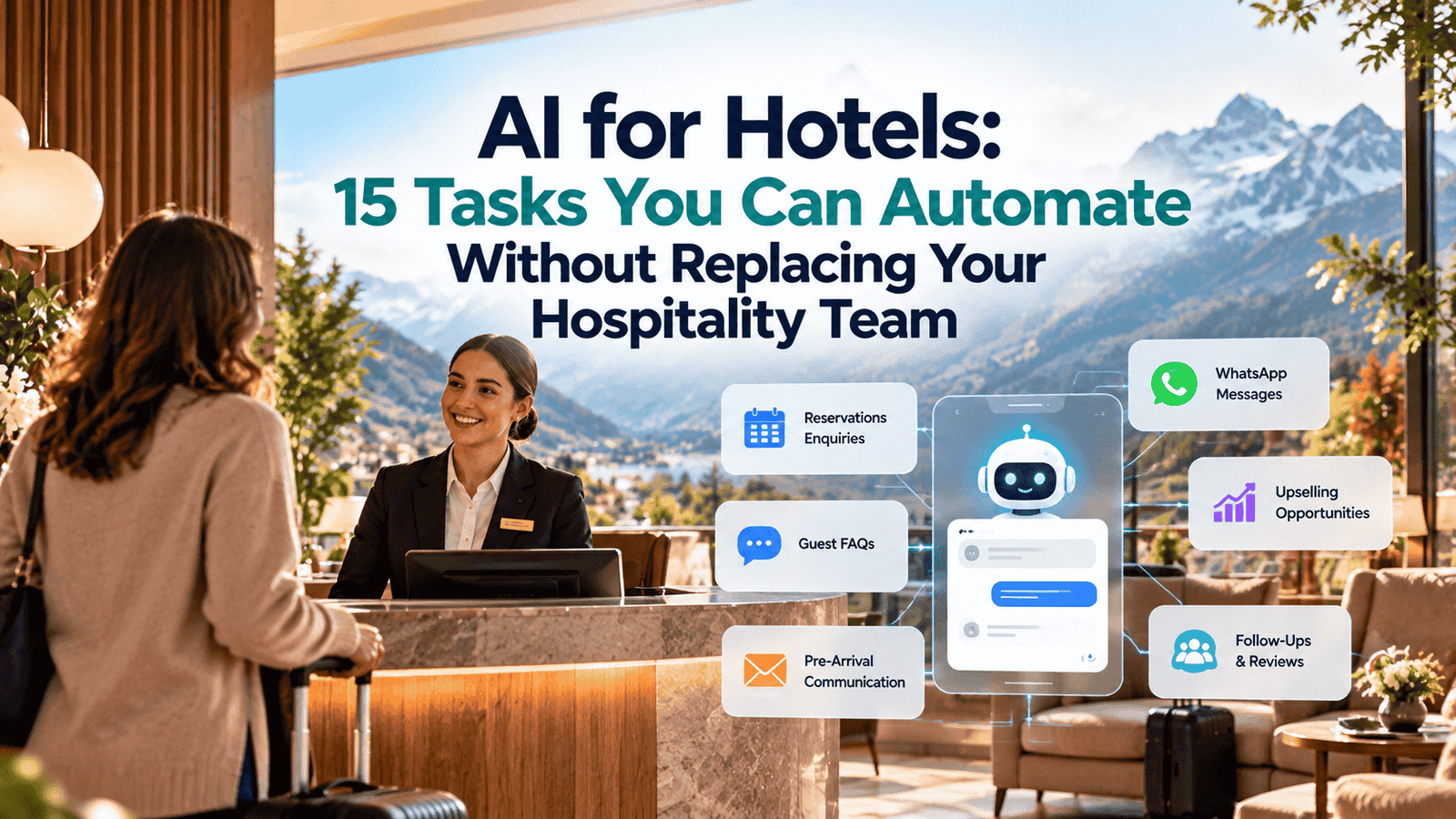
AI in hotels should not be about replacing hospitality teams. It should be about removing repetitive work that prevents those teams from focusing on guests.
Reservations, routine questions, WhatsApp messages, pre-arrival communication, upselling and follow-ups can consume hours of staff time every week. Many of these interactions follow predictable patterns and can be supported by AI hotel automation while employees remain available for situations that require judgment, empathy or personal attention.
The objective is simple: automate repetitive work, not hospitality.
Where AI Hotel Automation Creates Real Value
The best automation opportunities are usually high-volume, repetitive and rules-based tasks.
If employees repeatedly answer the same question, copy information between systems or manually send predictable messages, there may be an opportunity to automate part of that workflow.
Hotels should not begin by asking, “Where can we use AI?”
Start with: “Which repetitive tasks consume the most staff time without requiring human judgment every time?”
1. Answer Routine Guest Questions
Hotel teams repeatedly answer questions about check-in, checkout, parking, breakfast, Wi-Fi, facilities, directions and policies.
An AI assistant can handle appropriate routine questions using approved hotel information while escalating unusual or sensitive requests to staff.
The result is faster responses for guests and fewer repetitive enquiries for employees.
2. Handle Initial Reservation Enquiries
Potential guests may ask about rooms, dates, amenities or booking options before they are ready to reserve.
An AI receptionist for hotels can help handle initial enquiries and guide guests toward the appropriate booking process when connected to accurate information and suitable systems.
Staff can then focus on complex reservation requests and higher-value interactions.
3. Respond to WhatsApp Enquiries
WhatsApp can become difficult to manage when reservations, questions and service requests arrive continuously.
Automation can provide immediate responses to common questions, collect basic information and route conversations to the appropriate employee when human assistance is required.
The goal is not to remove staff from WhatsApp. It is to stop employees manually typing the same answers throughout the day.
4. Automate Pre-Arrival Communication
Guests often need similar information before every stay.
Arrival times, directions, parking instructions, check-in information and relevant hotel services can be communicated automatically at appropriate stages before arrival.
This gives guests useful information without requiring reception staff to manually send repetitive messages.
5. Identify Relevant Upsell Opportunities
Pre-arrival communication can also create appropriate opportunities to increase booking value.
Depending on the hotel, guests may be interested in breakfast, parking, room upgrades, transfers, late checkout or experiences.
Automation can present relevant options at suitable moments rather than depending entirely on staff remembering to offer them.
This connects operational automation directly with potential ancillary revenue.
6. Route Guest Requests to the Right Team
Not every request belongs at reception.
A maintenance issue may need operations. A restaurant request may belong with food and beverage. A billing question may need administration.
Automated workflows can categorize suitable requests and send them to the responsible person or department.
This reduces unnecessary internal forwarding and helps create clearer accountability.
7. Send Booking Confirmations and Useful Follow-Ups
Booking confirmations are essential but repetitive.
Automation can send consistent confirmation information and trigger additional communication based on the reservation journey.
The hotel can maintain a reliable communication process without requiring employees to manually manage every routine message.
8. Support Multilingual Guest Communication
Independent hotels often serve international guests while having limited multilingual staff coverage.
AI-assisted communication can help teams handle appropriate routine interactions across multiple languages.
However, hotels should maintain human oversight for important, sensitive or ambiguous conversations where translation accuracy and context matter.
Used carefully, AI can help reduce language friction without pretending technology can replace human communication entirely.
9. Recover Incomplete Booking Interest
Some potential guests check rooms or begin a booking journey without completing it.
Where the hotel's systems, consent and applicable privacy requirements allow, automated workflows can help reconnect with suitable prospects or support remarketing activity.
The objective is to recover qualified demand rather than simply sending more messages.
A connected hotel digital growth and automation system can combine booking data, marketing and communication around the guest journey.
10. Automate Post-Stay Feedback Requests
Hotels need guest feedback, but manually contacting every guest is inefficient.
An automated post-stay workflow can request feedback at an appropriate time and direct responses into the hotel's existing guest-experience process.
Staff can spend more time responding to feedback that actually requires attention instead of manually initiating every request.
11. Support Review Management
AI can assist staff by organizing reviews, identifying recurring themes and preparing draft responses for human approval.
For example, repeated comments about breakfast, parking or check-in can be grouped so management can identify operational patterns.
Hotels should avoid publishing unreviewed automated responses to sensitive complaints.
The real value is helping staff process information faster while preserving human judgment.
12. Re-Engage Previous Guests
Previous guests already know the hotel, making them an important audience for future direct-booking activity.
With appropriate consent and guest data, automated campaigns can support seasonal communication, relevant offers and repeat-stay opportunities.
This can help the hotel maintain an owned guest relationship instead of depending entirely on third-party platforms to reacquire previous customers.
13. Automate Internal Notifications
Automation can also work behind the scenes.
A specific booking type could notify the appropriate department. A VIP arrival could create an internal task. A maintenance request could be assigned automatically. An unresolved enquiry could trigger a follow-up reminder.
Small automations can remove dozens of manual handoffs across hotel operations.
The commercial benefit is greater consistency and less staff time spent coordinating routine activity.
14. Create Management Summaries
Hotel managers often gather information from several systems before they can understand what happened during the day or week.
Where appropriate data integrations are available, automation can consolidate information into useful summaries or dashboards.
This might include reservation activity, enquiry volumes, recurring guest questions or outstanding operational tasks.
AI should support decision-making rather than make important management decisions without appropriate oversight.
15. Connect Repetitive Work Across Hotel Systems
The biggest automation opportunity may not be a chatbot.
It may be connecting systems that currently require employees to move information manually between the booking engine, PMS, CRM, email, WhatsApp, forms or other tools.
Integrations can allow one event to trigger the next appropriate action.
For example:
New reservation → guest record → confirmation → pre-arrival communication → relevant upsell opportunity → post-stay follow-up
The exact workflow depends on the hotel's existing technology and available integrations.
At Oxmite, our approach combines AI reception, workflow automation and system integrations around the hotel's actual operational processes rather than adding isolated AI tools.
What Hotels Should Not Automate Completely
Hospitality depends on human judgment.
Complaints, emergencies, unusual requests, emotionally sensitive situations and high-value guest interactions may require employees rather than automated responses.
AI can collect information or assist staff, but hotels should define clear escalation rules.
A useful principle is:
Automate predictable work. Assist complex work. Keep people responsible for hospitality.
This approach helps hotels improve efficiency without turning the guest experience into a sequence of impersonal automated interactions.
Start With the Highest-Value Automation Opportunity
Do not attempt to automate all 15 areas at once.
Look at where employees currently spend repetitive time.
Which questions are answered dozens of times? Which messages are manually copied? Which follow-ups are regularly forgotten? Which information moves between systems by hand?
Then evaluate each opportunity based on frequency, staff time, guest impact, integration complexity and business value.
The best first automation is often a simple workflow that solves a frequent operational problem.
AI Should Give Your Hospitality Team More Time for Hospitality
The purpose of AI for hotels is not to create a hotel without people.
It is to give employees more time for the work where people create the most value.
When routine questions, notifications, follow-ups and data movement are automated appropriately, reception and operations teams can spend more attention on guests who genuinely need assistance.
Technology handles repetition. People handle hospitality.
Final Takeaway
AI hotel automation can support reservations, FAQs, WhatsApp enquiries, pre-arrival communication, upselling, guest requests, reviews, repeat bookings and internal workflows.
But automation should begin with the business process, not the technology.
Identify repetitive tasks first. Decide what can safely be automated. Define where human intervention remains necessary. Then connect the appropriate systems around that workflow.
At Oxmite, we help hotels identify and implement practical AI reception, workflow automation and integration opportunities around their existing operations.
Not sure what your hotel should automate first?
Identify Your Best Automation Opportunities and determine which repetitive hotel processes are worth automating, which should remain human-led and where AI can assist your existing team.