
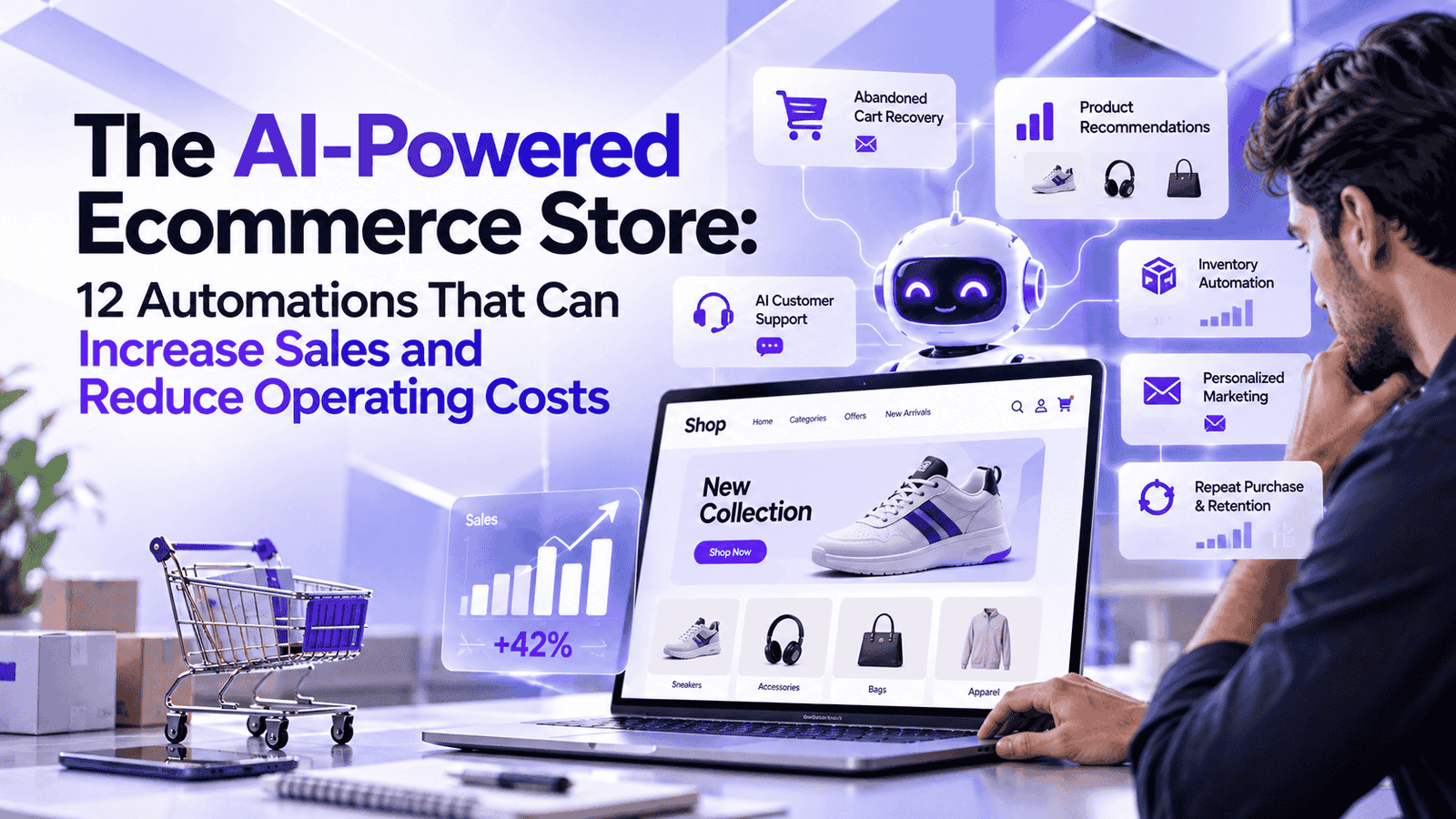
AI should not be added to an ecommerce store simply because it is popular. The real opportunity is to use AI ecommerce automation where it can increase sales, improve customer experience or reduce repetitive operating work.
For ecommerce owners, the strongest automation opportunities usually sit where customer behavior, repetitive workflows and existing business data meet.
1. Personalize Product Recommendations
Showing every customer the same products can make large catalogs harder to navigate.
AI-assisted recommendation systems can use appropriate browsing, purchase and product data to surface more relevant products based on customer behavior and context.
The business objective is simple: help shoppers discover suitable products faster while creating more opportunities for cross-selling and upselling.
2. Automate Abandoned Cart Recovery
A customer who adds a product to their cart has already demonstrated meaningful purchase intent.
Automated cart-recovery workflows can reconnect with eligible shoppers through email, messaging or other appropriate channels when consent and applicable requirements allow.
AI can also help segment abandoned carts so the business does not treat every shopper identically.
The bigger opportunity is not only recovering carts. It is understanding why customers abandon them and improving the checkout experience accordingly.
3. Answer Repetitive Customer Questions
Ecommerce support teams repeatedly answer questions about delivery, returns, availability, sizing, payment and order status.
An AI customer assistant can handle suitable routine questions using approved business information while escalating complex cases to employees.
This can provide faster answers to customers while reducing repetitive support workload.
4. Automate Order Status Enquiries
“Where is my order?” can become one of the most repetitive support requests for an ecommerce business.
When ecommerce, fulfilment and shipping systems can be appropriately integrated, customers may be able to retrieve order information automatically.
Instead of an employee manually checking each request, the system can provide available status information and escalate exceptions.
That allows support teams to focus on delayed, missing or problematic orders that actually require intervention.
5. Segment Customers Automatically
A first-time visitor, loyal customer, inactive buyer and high-frequency customer should not necessarily receive the same communication.
AI-assisted segmentation can help organize customers using relevant behavioral and transaction data.
Businesses can then create more appropriate campaigns based on purchase history, product interests, customer lifecycle stage, engagement and repeat-purchase behavior.
The objective is better relevance, not simply sending more marketing messages.
6. Personalize Ecommerce Marketing
Once customer segments are clearer, automation can make marketing communication more relevant.
A returning customer might receive communication related to products they previously purchased, while an inactive customer might enter a different re-engagement journey.
AI can assist with audience selection, product recommendations and message variations while the business maintains control over offers, brand voice and campaign rules.
A connected ecommerce development and automation strategy can bring customer data, marketing and store activity into a more coordinated system.
7. Improve Product Merchandising
Large ecommerce catalogs create another challenge: deciding what products customers should see first.
AI-assisted merchandising can use appropriate store data to help identify relevant products, categories and combinations for different shopping contexts.
This can support product discovery without requiring employees to manually rearrange every collection.
Human oversight remains important, particularly when merchandising decisions involve brand strategy, promotions, seasonality or commercial priorities that data alone may not understand.
8. Automate Inventory Alerts and Operational Workflows
Inventory problems affect both revenue and customer experience.
Automation can monitor appropriate inventory data and trigger actions when defined conditions occur.
For example, a workflow could notify the purchasing team when stock reaches a specified threshold or flag products requiring attention.
Where systems support suitable integrations, inventory events can also connect with ecommerce, warehouse and operational workflows.
The result is less dependence on employees repeatedly checking systems manually.
9. Identify Upsell and Cross-Sell Opportunities
The right additional product can increase order value while also improving the customer's purchase.
A customer buying a device may need a compatible accessory. Someone purchasing one item from a collection may be interested in a complementary product.
AI-assisted recommendation systems can help identify these relationships from product and customer data.
A useful recommendation improves the buying experience. An irrelevant recommendation simply creates more noise.
10. Automate Post-Purchase Communication
The customer relationship should not end when payment is completed.
Order confirmations, delivery updates, product guidance, feedback requests and appropriate follow-up communication can often be automated.
Different workflows can be triggered according to what the customer purchased and where they are in the post-purchase journey.
This creates a more consistent experience without requiring staff to manually initiate every communication.
11. Re-Engage Customers and Encourage Repeat Purchases
Acquiring a customer once should not mean starting from zero the next time.
Where appropriate customer data and marketing consent are available, ecommerce automation can identify suitable opportunities for re-engagement.
For businesses selling replenishable products, the timing may relate to expected repurchase behavior. For other stores, it may involve new collections, complementary products or relevant seasonal campaigns.
The objective is to build stronger customer retention rather than depending entirely on acquiring new traffic for every future sale.
12. Connect Ecommerce Systems and Eliminate Manual Work
Some of the highest-value ecommerce automation happens behind the scenes.
Businesses often operate separate systems for their store, CRM, accounting, inventory, fulfilment, customer service and marketing.
Employees then become the connection between those systems.
A properly designed integration can allow one event to trigger the next appropriate action.
New order → Payment confirmation → Inventory update → Fulfilment workflow → Customer notification → CRM update → Post-purchase journey
The exact workflow depends on the business, its technology and available integrations.
At Oxmite, we approach ecommerce automation by examining the complete customer and operational journey rather than adding isolated AI tools.
Do Not Automate Everything Just Because You Can
Not every ecommerce process needs AI.
A simple rule-based automation may be enough for some tasks. Other processes may still require employees because they involve exceptions, judgment, negotiation or sensitive customer situations.
Start with the business problem.
Ask where sales are being lost, which repetitive tasks consume the most employee time, where customers are waiting unnecessarily and which systems require employees to transfer information manually.
These questions usually reveal better automation opportunities than starting with a list of AI features.
Build an Ecommerce Automation Roadmap
Trying to implement every automation simultaneously can create unnecessary complexity.
Start with a few opportunities that combine clear business value with realistic implementation effort.
A practical roadmap could begin with customer support, cart recovery or repetitive operational workflows before moving into deeper personalization, merchandising and cross-system automation.
Each automation should have a measurable purpose, such as reducing repetitive work, improving response times, increasing completed purchases or strengthening repeat-customer engagement.
Final Takeaway
AI ecommerce automation can support much more than a chatbot.
Product recommendations, abandoned-cart recovery, customer support, segmentation, personalized marketing, merchandising, inventory workflows, upselling, post-purchase communication and retention can all become part of a connected ecommerce system.
But the goal should never be automation for its own sake.
The strongest ecommerce automation strategy identifies where revenue is being lost, where customers experience friction and where employees spend unnecessary time on repetitive work.
At Oxmite, we combine ecommerce development, AI automation, integrations and customer-experience systems to build workflows around real commercial problems.
Not sure which ecommerce processes are worth automating first?
Build an Ecommerce Automation Roadmap to identify the highest-value opportunities across customer acquisition, conversion, support, operations and retention.