
The expensive mistake is not choosing the “wrong technology.” It is building more technology than the business problem requires — or too little to solve it properly.
When comparing a website vs mobile app vs web app, start with what users actually need to do. A business that needs visibility and leads has very different requirements from one that needs customer accounts, internal workflows, real-time tracking or frequent mobile engagement.
The right solution is usually the simplest digital product that solves the business problem today while leaving room to grow tomorrow.
Start With the Business Problem, Not the Platform
Do not begin with “we need an app” or “we need a new website.”
Start by defining the outcome.
Do you need more leads? Online sales? Customer self-service? Staff automation? A booking system? A member portal? Real-time tracking? Better internal operations?
Once the business process and target users are clear, choosing between a website, web app and mobile app becomes much easier.
A good digital product development strategy should recommend technology around the business objective rather than forcing the business into a predetermined platform.
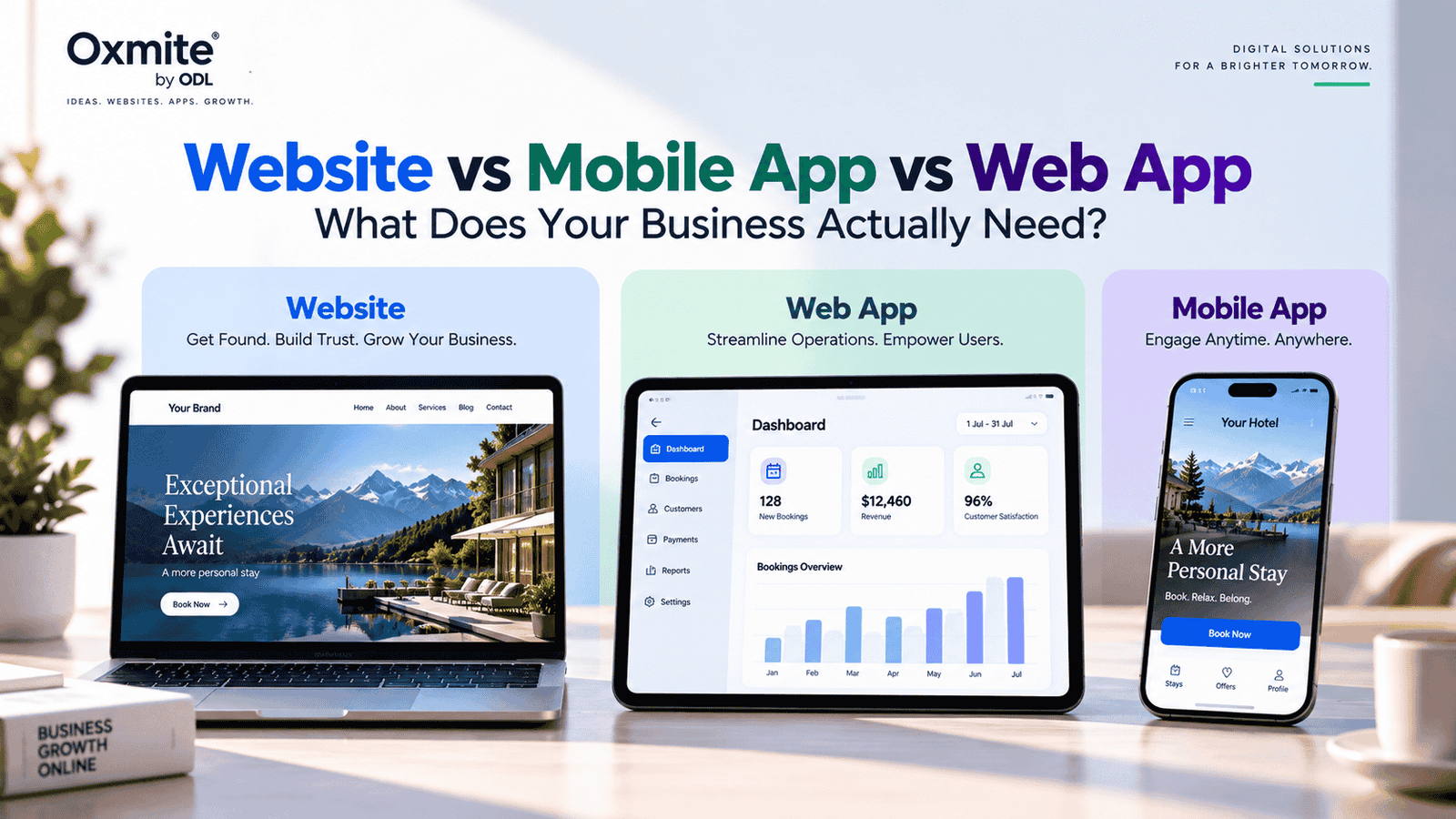
Choose a Website for Discovery, Credibility and Leads
A business website is usually the right starting point when the primary objective is to be found online, explain services, establish credibility and generate enquiries or sales.
A website is particularly useful for businesses that depend on Google Search, content marketing, SEO, landing pages and digital advertising.
For example, a hotel may need a website to present rooms and generate direct bookings. A professional services company may need one to generate qualified leads. An e-commerce business may use its website as the primary online sales channel.
If customers mainly need to find, understand, trust and contact or buy from your business, a strong website may be enough.
Choose a Web App for Workflows, Portals and Transactions
A web app becomes more appropriate when users need to log in and perform ongoing tasks rather than simply consume information.
Think about customer portals, dashboards, booking platforms, marketplaces, inventory systems, CRM tools and internal business software.
For example, a clinic could use a web app for patient appointments and records. A logistics company might need a dashboard for shipments and operations. A membership business could provide customers with accounts, subscriptions and protected resources.
Because web apps run through a browser, users can access them without installing traditional mobile software.
Custom web app development is particularly valuable when the goal is to digitize a business process rather than simply create an online presence.
Choose a Mobile App for Frequent Engagement
A mobile app makes more sense when users need to interact with the product frequently or when smartphone capabilities are central to the experience.
Examples include applications that rely heavily on push notifications, location, camera access, mobile-first workflows or certain offline experiences.
A delivery platform may need real-time driver interactions. A member application may use notifications to drive regular engagement. A field-service business may require staff to perform repeated tasks while away from a desk.
The key question is frequency.
If customers will use the product once every few months, convincing them to install an app may add unnecessary friction. If they interact with it every day, a mobile app can create much more strategic value.
When a Web-First Approach May Be Enough
Businesses sometimes assume they need separate iOS and Android apps before testing whether customers actually need them.
A responsive website or web app can often provide a strong experience across desktop, tablet and mobile browsers.
Starting web-first can also help validate the business model and user journey before expanding into additional interfaces.
The decision should be based on functionality rather than trends. If the essential experience works well in a browser, building native mobile apps immediately may not be necessary.
When iOS and Android Apps Create Strategic Value
Dedicated mobile apps become more valuable when mobile functionality is part of the core product rather than simply another way to access it.
Consider mobile apps when your solution depends strongly on repeated engagement, notifications, location-aware experiences, camera functionality or other device capabilities.
A marketplace with frequent buyers and sellers, a field-service platform or a customer loyalty product may eventually benefit from dedicated apps.
But the mobile application should solve a measurable user or business problem. Having an app is not itself a business outcome.
When You Need Website + Web App + Mobile App
Some businesses genuinely need multiple interfaces.
Imagine a service marketplace.
The public website attracts customers through Google and explains the service. The web app allows customers and administrators to manage accounts, transactions and operations. The mobile app gives frequent users convenient access and notifications.
An integrated system can therefore look like:
Website → Discovery and acquisition
Web App → Accounts, workflows and management
Mobile App → Frequent engagement and mobile functionality
These products should share a coordinated backend, data model and business logic where appropriate rather than becoming disconnected systems.
This is where an integrated website, web app and mobile app development approach can provide greater long-term value.
Website vs Web App vs Mobile App: How to Decide
Use a few practical questions before deciding what to build.
- Do users need to discover you through Google? A website is usually important.
- Do users need accounts, dashboards or complex workflows? Consider a web app.
- Will users interact with the product frequently from their phones? Consider a mobile app.
- Does the product need important device features or offline functionality? Evaluate a dedicated mobile app.
- Do you need both public discovery and private functionality? A website plus web app may be appropriate.
- Do different user groups require different interfaces? An integrated multi-platform solution may eventually make sense.
You do not need to answer the technical architecture yourself. You need to clearly describe the business process and desired outcome.
Common Mistakes When Planning a Digital Product
One of the biggest mistakes is starting with a long feature list before defining the core problem.
Another is building separate web and mobile products when one well-designed platform could handle the initial requirement.
The opposite mistake is equally expensive: choosing a basic website when the business actually needs user accounts, workflow automation, transactions or operational software.
Businesses can also underestimate the systems behind the visible interface. Authentication, databases, integrations, administration, analytics, security and infrastructure may be just as important as the screens customers see.
Good product planning determines what is necessary before development begins.
Start With an MVP and Expand Based on Evidence
Your first version does not need every feature you might want in three years.
Define the minimum viable product (MVP) around the most important user journey.
If you are building a marketplace, the first priority might be listing, discovery, accounts and transactions. Advanced automation and additional mobile features can follow after the core model has been validated.
This phased approach helps keep the initial project focused while allowing the technology to expand as the business learns what customers actually use.
What a Development Partner Needs Before Estimating
You do not need to prepare a technical specification before speaking with a development company.
Start with the business information.
Explain what your company does, who will use the solution, how the process currently works, what problem you want to eliminate and what users should be able to accomplish.
Also identify any essential integrations, important timeline requirements and known budget constraints.
A capable development partner should translate those business requirements into an appropriate technical solution rather than expecting you to choose the architecture first.
Not Sure What Your Business Actually Needs?
You may need a website. You may need a custom web application. You may need dedicated iOS and Android apps. Or you may eventually need all three.
The important decision is not which option sounds more advanced. It is which architecture creates the clearest business value without unnecessary complexity.
At Oxmite, we design and develop websites, custom web applications, mobile apps and integrated digital platforms around real business requirements.
You do not need to know the technical answer — describe the business process and we will recommend the appropriate architecture.
Request a Free Digital Solution Recommendation and tell us what your business needs to accomplish.
Final Takeaway
When deciding between a website vs mobile app vs web app, start with user behavior and the business outcome.
Choose a website when discovery, credibility, SEO and lead generation are the priority. Choose a web app when users need accounts, transactions, dashboards or workflows. Consider a mobile app when frequent engagement or mobile-specific capabilities create meaningful value.
If the business needs several of these capabilities, build an integrated platform in phases rather than creating disconnected products.
The best digital solution is not necessarily the biggest one. It is the one that solves the business problem properly and can grow when the business needs more.