
Your real estate business may be generating leads from Google, property portals, WhatsApp, social media and your website, but how many of those enquiries actually turn into property viewings and completed deals?
For many real estate agencies, the problem is not simply a lack of leads. It is that enquiries, conversations, property information and sales activity are scattered across disconnected systems.
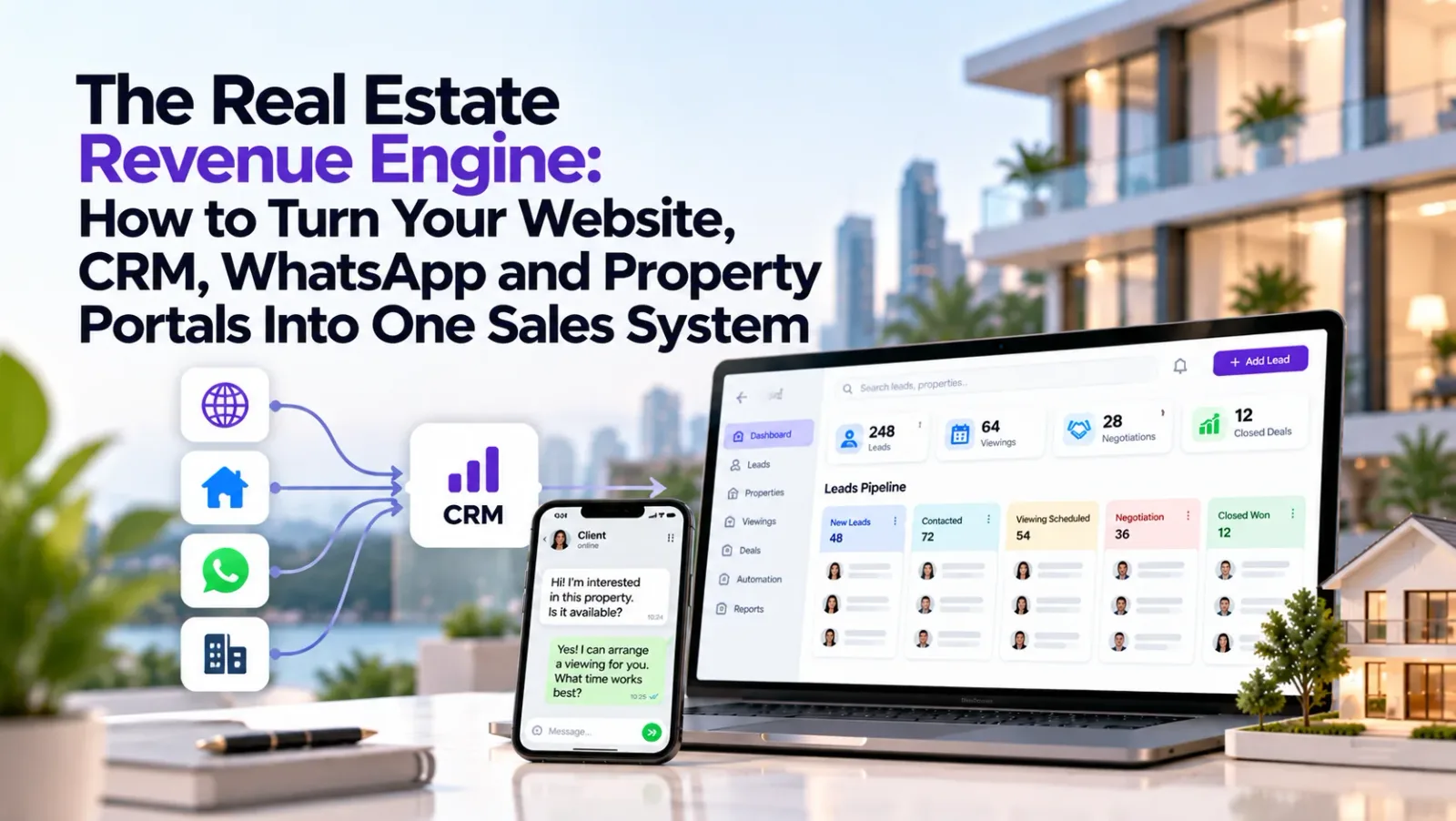
A modern real estate sales automation system connects your website, CRM, WhatsApp, property portals and sales team into one measurable workflow.
The objective is simple: capture more qualified enquiries, respond faster, prevent missed follow-ups and give management better visibility into the sales pipeline.
Why Real Estate Businesses Lose Leads Between Different Platforms
A potential buyer might discover a property on a portal, send a WhatsApp message, request a viewing and then wait for an agent to respond.
Meanwhile, another enquiry arrives through the website, a third comes from Facebook advertising and several others are sitting in individual agents' inboxes.
When these conversations are managed separately, important opportunities can be overlooked.
Agents may forget follow-ups, contact the same lead twice or struggle to understand which properties a buyer has already viewed.
The business needs more than a collection of communication tools. It needs a connected process that turns enquiries into managed sales opportunities.
1. Connect Every Lead Source to One CRM
Your real estate website, property portals, advertising campaigns and messaging channels should not operate as separate lead databases.
A centralized CRM can organize enquiries from different sources into one structured sales pipeline.
Each lead can include relevant information such as property interest, budget, preferred location, enquiry source, assigned agent and follow-up status.
Where supported, integrations can automatically transfer enquiries into the CRM instead of requiring agents to copy information manually.
This helps the business maintain a clearer record of its opportunities and reduces the risk of losing leads between platforms.
2. Turn Your Real Estate Website Into a Lead Generation System
A real estate website should do more than display property listings.
It should help potential buyers and investors find relevant properties, understand their options and contact the agency without unnecessary friction.
Useful features include clear property information, search filters, enquiry forms, viewing requests and mobile-friendly navigation.
When website enquiries connect directly to the CRM, agents can receive the information needed to respond appropriately.
A well-designed real estate website and CRM integration can therefore support both lead generation and sales management.
The goal is to move visitors from property discovery into a structured sales process.
3. Connect Property Portal Enquiries With Your Sales Pipeline
Property portals can generate valuable enquiries, but those leads often remain inside separate dashboards, emails or messaging systems.
Agents may need to check several platforms throughout the day.
Where property portals provide supported APIs, lead notifications, webhooks or approved integration methods, enquiries can be routed into the agency's CRM.
This allows management to compare enquiries from different portals and understand which sources contribute to qualified leads, viewings and completed transactions.
The business benefit is not simply collecting more data.
It is gaining control over enquiries that would otherwise remain fragmented.
4. Integrate WhatsApp With Your Real Estate CRM
WhatsApp is a useful communication channel for many real estate businesses.
Buyers may use it to ask about property availability, request details, arrange viewings or follow up with agents.
However, when conversations remain only on individual employees' phones, management may have limited visibility into customer communication.
A properly configured WhatsApp Business integration can connect permitted conversations and lead activity with the CRM.
Agents can access relevant enquiry history, manage follow-ups and coordinate communication more consistently.
Automation should respect customer messaging preferences, consent requirements and WhatsApp's applicable business messaging policies.
5. Use AI to Qualify Property Enquiries
Not every property enquiry represents the same level of buying intent.
Some people are actively looking to purchase, while others are researching prices, comparing locations or exploring future investment opportunities.
An AI-powered lead qualification workflow can help collect basic information before an agent begins a detailed conversation.
For example, the system may ask about preferred property type, location, budget range and viewing availability.
Based on defined business rules, enquiries can then be organized or routed to the appropriate team.
AI should support lead qualification, not make sensitive eligibility or discriminatory housing decisions.
Human agents remain responsible for important sales conversations and decisions.
6. Automate Lead Assignment and Follow-Ups
One of the biggest operational challenges in real estate is maintaining consistent follow-up.
A potential buyer may enquire about several properties before arranging a viewing or making a decision.
Without a structured process, agents may forget to reconnect with interested leads.
A connected CRM can assign enquiries according to agreed business rules, create follow-up tasks and notify agents when action is required.
Appropriate automated messages can acknowledge enquiries or confirm viewing requests, while important negotiations remain with the sales team.
The result is a more consistent sales process that depends less on individual memory.
7. Manage Property Viewings and Sales Stages in One Place
Real estate sales rarely happen after a single conversation.
The process may include initial enquiry, qualification, property recommendations, viewing arrangements, negotiation, documentation and final transaction.
When these stages are managed through separate spreadsheets and conversations, it becomes difficult to see what is happening across the business.
A custom real estate CRM can organize the pipeline into clear stages.
For example:
New Enquiry → Qualified Lead → Viewing Scheduled → Viewing Completed → Negotiation → Deal Closed
Agents can update progress while management monitors the overall pipeline.
This makes it easier to identify delayed opportunities, outstanding tasks and sales activities requiring attention.
8. Automate Property Viewing Confirmations and Reminders
Arranging property viewings often requires repeated communication between agents, buyers, sellers and property managers.
A connected workflow can help coordinate viewing requests, confirmations and reminders.
For example, once a viewing is approved, the system can send appropriate appointment information to the relevant participants.
If a viewing is cancelled or rescheduled, the workflow can update the CRM and notify the assigned agent.
This reduces repetitive coordination and helps keep appointment information consistent.
9. Give Management a Real-Time Sales Dashboard
Real estate business owners need more than a monthly spreadsheet showing the number of enquiries received.
They need visibility into what happens after each enquiry enters the business.
A connected reporting dashboard can show:
- Leads generated by each channel
- Qualified enquiries
- Agent follow-up activity
- Property viewings scheduled
- Deals progressing through the pipeline
- Completed transactions
- Marketing and acquisition costs
These reports can help management identify which channels and activities contribute to meaningful business outcomes.
Instead of making decisions based only on lead volume, the agency can evaluate the quality and progression of its sales opportunities.
10. Connect Marketing Performance With Actual Property Sales
Generating leads is only one part of real estate marketing.
A campaign may produce hundreds of enquiries but relatively few qualified buyers.
Another campaign may generate fewer leads while contributing more completed transactions.
When marketing platforms and CRM data are appropriately connected, the business can better evaluate the relationship between advertising activity, qualified enquiries and sales outcomes.
This creates a stronger foundation for allocating marketing budgets.
The objective is not simply more leads at a lower cost.
It is more qualified opportunities and a clearer understanding of the revenue generated from marketing investment.
11. Build a Custom CRM Around Your Agency's Workflow
Every real estate business operates differently.
A residential agency may focus on buyer enquiries and property viewings, while a commercial property business may manage longer negotiations, multiple stakeholders and complex documentation.
Standard CRM platforms can support many common requirements, and custom development is not always necessary.
However, when the business requires specialized lead routing, property matching, reporting, integrations or approval workflows, custom CRM development may become valuable.
At Oxmite, we help businesses evaluate their existing systems and design integrations, custom software and AI automation around actual operational requirements.
The goal is to create technology that supports how the business works rather than forcing the business into unnecessary manual processes.
12. Start With One Connected Sales Workflow
You do not need to rebuild every system at once.
Start by identifying where enquiries currently arrive, how agents respond and where follow-ups are most frequently delayed or lost.
Then connect the most important lead sources to a central CRM and establish clear sales stages.
Once the foundation is working, add suitable automation for lead assignment, enquiry responses, viewing coordination and management reporting.
AI capabilities can be introduced where they solve a genuine operational problem.
This phased approach helps the business improve its sales process without introducing unnecessary complexity.
Build a Real Estate Revenue Engine That Works Across Every Channel
A real estate agency does not necessarily need more disconnected marketing tools.
It needs a coordinated system that connects lead generation, customer communication, agent activity and sales reporting.
Your website attracts enquiries. Property portals introduce potential buyers. WhatsApp supports conversations. The CRM organizes opportunities. Automation improves follow-up consistency. Reporting helps management understand performance.
Together, these components create a more measurable real estate sales automation system.
At Oxmite, we build custom CRM solutions, systems integrations and AI-powered workflows that help businesses reduce manual coordination and manage sales opportunities more effectively.
The objective is to help your team spend less time managing disconnected information and more time progressing qualified opportunities.
Final Takeaway
Your real estate business may already be generating valuable demand through websites, property portals, WhatsApp and advertising.
The challenge is making sure those enquiries move through a consistent process from first contact to completed transaction.
A connected real estate sales automation system can centralize lead information, improve follow-up, coordinate property viewings and provide clearer sales reporting.
The strongest solution combines the tools your agency already uses with the integrations and automation it actually needs.
Are your property enquiries scattered across different platforms and individual agents?
Build a Unified Sales Workflow with Oxmite and discover how your website, CRM, WhatsApp, property portals and AI automation can work together as one connected sales system.