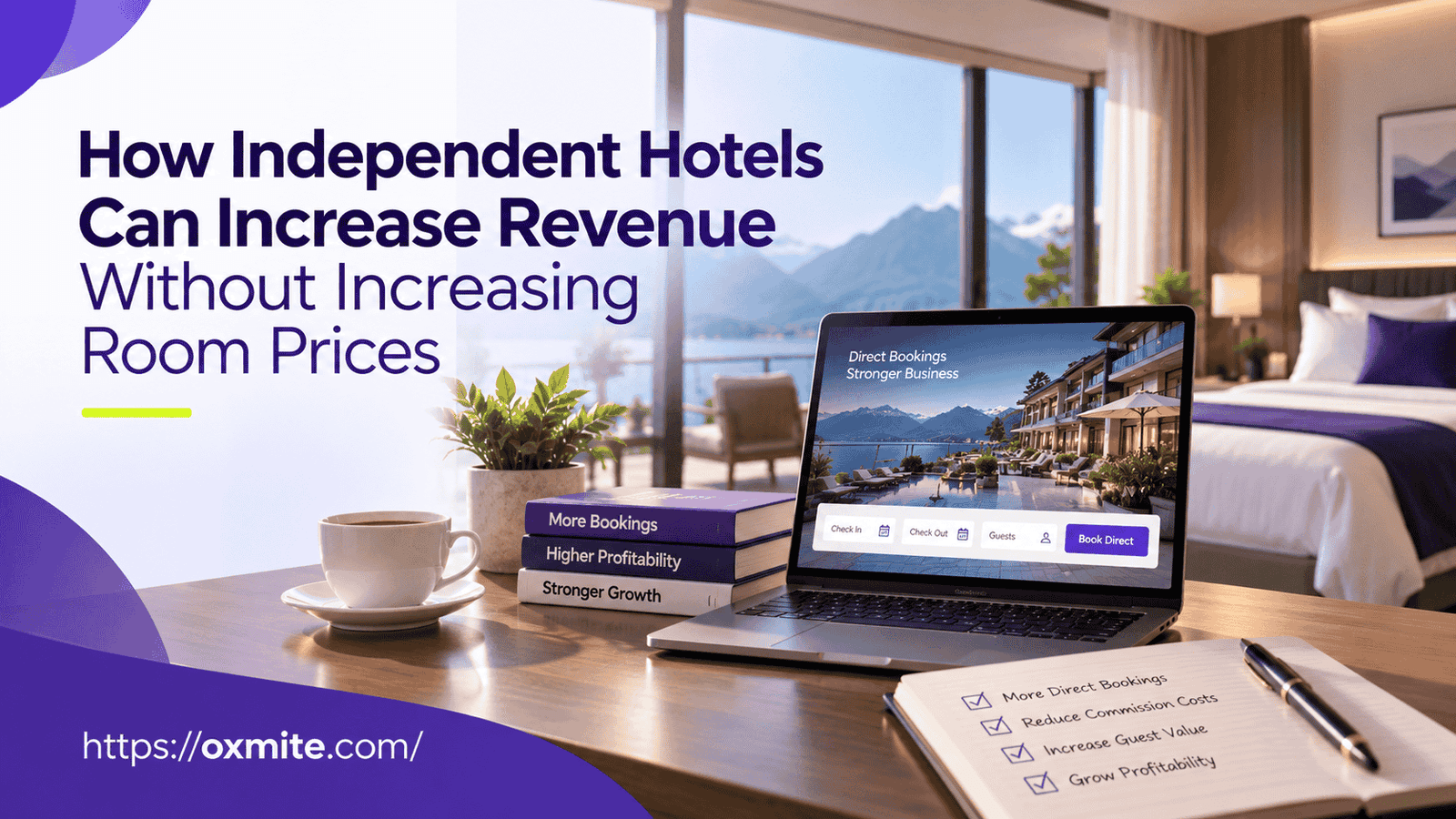
How Independent Hotels Can Increase Revenue Without Increasing Room Prices
You may not need more guests or higher room prices to increase hotel revenue. You may need a more profitable way to acquire, convert and retain the guests you already attract.
For many independent hotels, revenue growth is treated mainly as a pricing problem. But raising room rates is only one option. Improving your booking mix, direct-booking contribution, website conversion and guest value can strengthen profitability without increasing standard room prices.
The goal is not simply to generate more top-line revenue. It is to retain more revenue from each booking while improving control over acquisition costs and guest relationships.
Revenue Versus Net Retained Revenue
Room revenue and retained revenue are not the same thing.
A hotel can generate strong gross room revenue while losing part of that value through OTA commissions, distribution fees and customer acquisition costs.
A useful way to think about hotel profitability is:
Net retained revenue = booking revenue - distribution costs - acquisition costs
This changes the commercial question from:
How can we charge guests more?
to:
How can we retain more from the demand we already generate?
For independent hotels, improving the booking mix can therefore be just as important as increasing room prices.
A broader hotel growth and direct-booking strategy should look at both revenue generation and how much revenue the hotel actually retains after acquisition and distribution costs.
Increase Your Direct Booking Share
A stronger direct-booking channel gives your hotel more control over how reservations are generated and how much revenue is retained.
Direct bookings can help hotels:
- Reduce unnecessary reliance on third-party booking channels
- Retain more revenue from suitable reservations
- Build stronger guest relationships
- Create repeat-booking opportunities
- Promote packages and additional services directly
- Better understand which marketing activities generate bookings
This does not mean OTAs should disappear from your strategy.
OTAs can remain useful for visibility, discovery and distribution. The objective is to create a healthier balance between third-party bookings and reservations generated through your own website.
A complete hotel direct-booking solution can combine the website, booking technology, digital marketing and conversion strategy needed to strengthen this owned channel.
Reduce Unnecessary Hotel Commission Costs
Every booking channel has an acquisition cost.
If a guest already knows your hotel, searches for your brand or visits your website, directing that demand back through a commission-based third-party channel can reduce the amount of revenue your hotel retains.
Pay particular attention to audiences that already show strong booking intent:
- Previous guests
- Branded Google search visitors
- Website visitors
- Email subscribers
- Social media followers
- Referral traffic
- Guests referred by previous customers
These audiences can be particularly valuable for a direct-booking strategy.
A better booking mix is not only about generating more reservations. It is about improving the quality and profitability of those reservations.
Improve Your Hotel Website Conversion Rate
More website traffic does not automatically create more revenue.
If potential guests visit your website but struggle to understand rooms, compare offers or complete a reservation, part of that demand may be lost.
Review your booking journey from the guest's perspective.
Ask:
- Can visitors understand the hotel offer quickly?
- Are rooms clearly presented?
- Is availability easy to check?
- Is the booking engine mobile-friendly?
- Are prices and packages easy to understand?
- Are booking buttons easy to find?
- Does the website build trust?
- Is important information easy to access?
- Are there unnecessary steps before booking?
Improving conversion can generate more bookings from the traffic you already receive without increasing room prices or advertising spend.
Your hotel website should function as a revenue channel. A professionally designed hotel website and digital growth system can help connect traffic generation with a clearer direct-booking journey.
Use Packages and Value-Added Direct Offers
You do not always need to discount a room to make direct booking more attractive.
Instead, create additional value around the reservation.
Examples can include:
- Breakfast-inclusive packages
- Parking
- Flexible booking conditions
- Welcome amenities
- Local activity packages
- Restaurant benefits
- Seasonal experiences
- Longer-stay packages
A direct offer should provide genuine value to the guest while remaining commercially sensible for the hotel.
This makes the direct channel more attractive without automatically lowering the room rate.
Upsell Rooms, Add-Ons and Experiences
A guest's revenue potential does not end with the room price.
Relevant upsells can increase total booking value without changing the standard price of the original room.
Depending on the property, opportunities may include:
- Room upgrades
- Early check-in
- Late check-out
- Breakfast
- Parking
- Airport transfers
- Restaurant reservations
- Spa treatments
- Local tours
- Equipment rental
- Romantic packages
- Celebration packages
The strongest hotel upselling strategy focuses on relevance rather than simply showing more offers.
A well-timed upgrade or add-on can improve both guest convenience and hotel revenue.
Encourage Longer Stays and Shoulder-Night Demand
Increasing average length of stay can improve booking value without increasing the nightly room rate.
For example, converting a two-night stay into a three-night stay creates more revenue from the same customer acquisition opportunity.
Hotels can encourage longer stays through:
- Multi-night packages
- Destination itineraries
- Experience bundles
- Midweek incentives
- Extended-stay benefits
- Seasonal packages
It is also useful to identify weaker nights around stronger periods.
If Friday and Saturday perform well but Thursday or Sunday is weaker, targeted offers can help create additional shoulder-night demand.
Retarget Website Visitors Who Did Not Book
Many travellers do not complete a reservation during their first website visit.
They may compare hotels, discuss plans with another traveller or return after confirming their dates.
Retargeting can help reconnect with visitors who:
- Viewed room pages
- Checked special offers
- Visited the booking engine
- Read destination content
- Engaged with your website
- Left without completing a reservation
Instead of spending your full marketing budget on reaching completely new audiences, retargeting allows you to focus part of that budget on people who have already shown interest.
This is where hotel digital marketing can support the direct-booking strategy by reconnecting with qualified visitors rather than relying only on new traffic.
Build Repeat Booking Campaigns From Owned Guest Data
Previous guests can be one of the most valuable audiences available to an independent hotel.
Where guest data can be used in accordance with applicable privacy and marketing requirements, hotels can create campaigns designed to encourage future direct reservations.
Examples include:
- Seasonal return campaigns
- Previous-guest offers
- Destination updates
- New package announcements
- Event-based promotions
- Stay anniversary campaigns
- Returning guest benefits
A returning guest already knows your hotel and understands the experience.
Building an owned relationship with that guest can reduce the need to repeatedly reacquire the same customer through third-party channels.
Improve Organic Search and Destination Demand Capture
Potential guests search for much more than hotel names.
They also search for destinations, attractions, experiences and travel ideas.
Useful hotel SEO content can target searches such as:
- Hotels near local attractions
- Where to stay in a destination
- Family-friendly hotels
- Ski hotels
- Hiking accommodation
- Romantic stays
- Hotels near transport connections
- Seasonal travel guides
- Local events and experiences
Creating useful destination content can help your hotel capture qualified organic demand and bring potential guests directly to your website.
This strengthens your owned acquisition channel over time.
Combining hotel SEO, content marketing and direct-booking optimization can help turn organic visibility into commercially valuable website traffic.
Use Automation to Reduce Manual Sales and Communication Effort
Hotel revenue growth is also connected to operational efficiency.
Teams often spend significant time repeatedly answering similar questions or manually sending similar communications.
Automation can support:
- Booking confirmations
- Pre-arrival communication
- Frequently asked questions
- Upsell messages
- Post-stay follow-ups
- Review requests
- Repeat-booking campaigns
Automation should support personal hospitality rather than replace it.
The benefit is fewer repetitive tasks, more consistent communication and more time for your team to focus on higher-value guest interactions.
A connected hotel growth and marketing automation solution can help bring these activities together instead of managing them as isolated tasks.
Illustrative Scenario: Same Room Revenue, Different Profitability
Consider two hypothetical independent hotels.
Both generate 100,000 in room revenue during the same period.
Hotel A
- Room revenue: 100,000
- Higher dependence on commission-based booking channels
- Illustrative distribution and acquisition costs: 15,000
- Illustrative retained revenue before other operating costs: 85,000
Hotel B
- Room revenue: 100,000
- Stronger mix of suitable direct bookings
- Illustrative distribution and acquisition costs: 9,000
- Illustrative retained revenue before other operating costs: 91,000
Both hotels generated exactly the same room revenue.
However, in this illustrative example, Hotel B retains 6,000 more before other operating costs because its booking mix and acquisition costs are different.
These figures are hypothetical and are used only to explain the concept. Actual commission rates, acquisition costs and results will vary by hotel.
You may not need more guests or higher prices. You may need a better booking mix.
What Independent Hotels Should Measure
Occupancy and ADR are important, but they do not show the complete commercial picture.
Independent hotels should also monitor:
- Direct-booking share
- OTA booking share
- Distribution costs
- Customer acquisition cost
- Website conversion rate
- Average booking value
- Average length of stay
- Repeat guest contribution
- Upsell revenue
- Net revenue by booking channel
These metrics make it easier to understand which reservations are creating the most value for the business.
A Practical Hotel Revenue Growth Strategy
If your goal is to increase hotel revenue without immediately raising standard room prices, prioritize the following:
- Increase suitable direct bookings
- Reduce unnecessary commission leakage
- Improve website and booking-engine conversion
- Create value-added direct offers
- Upsell relevant rooms, services and experiences
- Encourage longer stays and shoulder-night bookings
- Retarget visitors who leave without booking
- Build repeat-booking campaigns
- Increase organic visibility through hotel SEO
- Automate repetitive sales and guest communication
Each step focuses on margin, conversion, retention, efficiency or control rather than simply charging guests more.
Hotels looking for a more integrated approach can explore Oxmite's hotel digital growth solutions to connect these areas into one strategy.
Increase Hotel Revenue by Improving Your Booking Mix
You do not always need to increase ADR to increase hotel revenue and improve profitability.
Your hotel may already generate valuable demand, but some of that demand may be lost through weak website conversion, excessive dependence on commission-based channels, limited upselling or poor follow-up with previous guests.
A stronger combination of direct bookings, conversion optimization, SEO, upselling, retention and automation can create a more efficient revenue model.
You may not need more guests. You may need a better booking mix.
Request a Free Revenue Channel Assessment to identify where your hotel may be losing margin and where direct-booking, conversion and retention opportunities could be improved.
You can also request a Free Revenue Channel Assessment to identify potential gaps in your hotel's booking mix, conversion strategy and direct-booking system.