
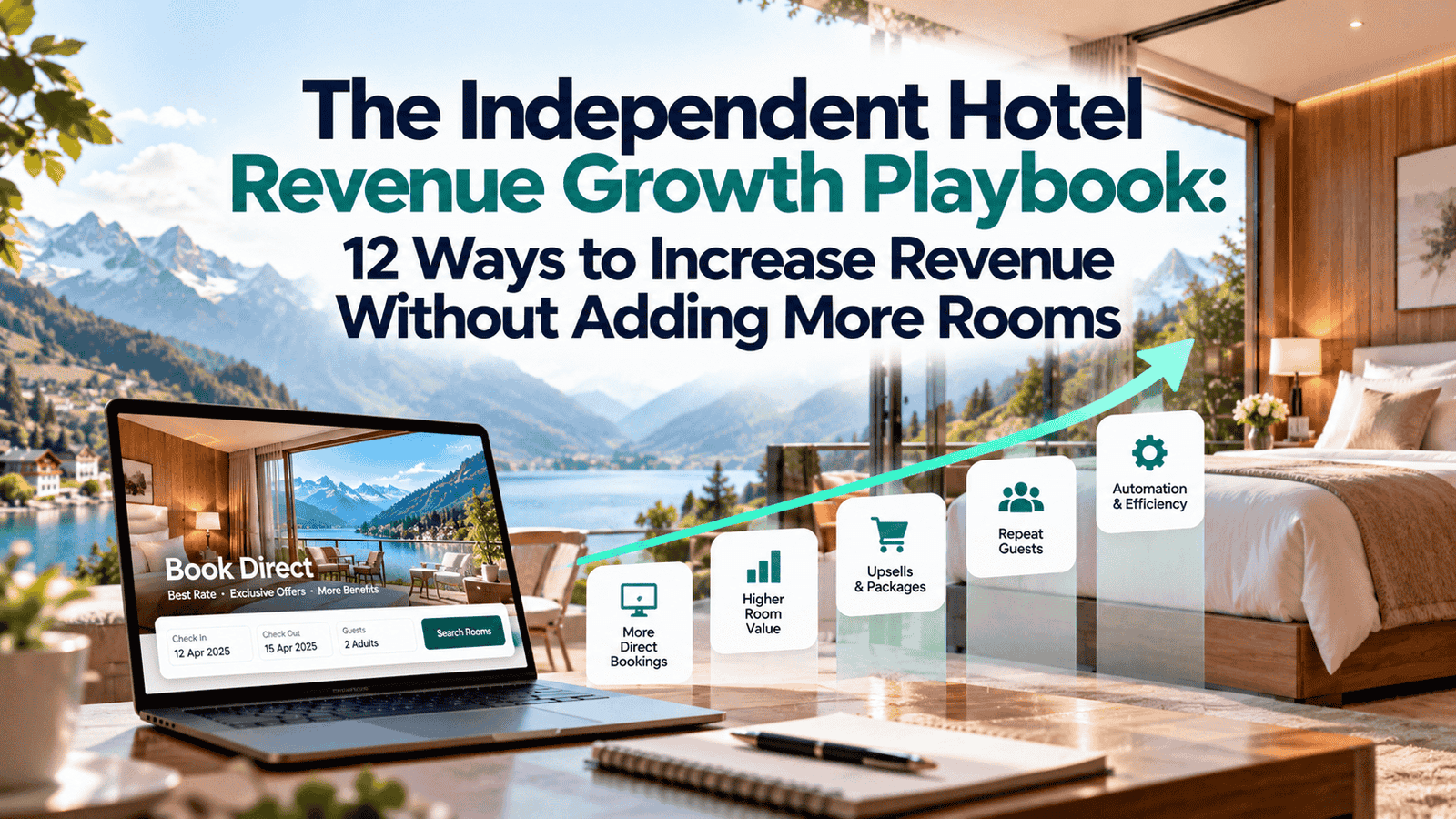
A hotel does not always need more rooms to generate more revenue.
For many independent hotels, the bigger opportunity is improving the commercial performance of the rooms, guests and demand they already have. That means looking beyond occupancy and room rates to direct bookings, conversion, upselling, packages, repeat stays, guest data and operational efficiency.
A practical hotel revenue growth strategy focuses on increasing the value of existing demand while improving how efficiently the hotel acquires and serves guests.
1. Increase Your Share of Direct Bookings
A booking can generate the same room revenue through different channels while having different acquisition and distribution costs.
Strengthening the direct channel gives the hotel another way to acquire reservations through its own website and booking engine.
The objective is not necessarily to eliminate OTAs. It is to create a healthier booking mix and reduce unnecessary dependence on third-party distribution.
A strong hotel direct-booking strategy connects the website, booking engine, search visibility and marketing around this objective.
2. Convert More Website Visitors Into Guests
Before spending more money attracting visitors, examine what happens to the traffic you already receive.
A potential guest may visit the website, view rooms and check availability but abandon before booking because something creates uncertainty or friction.
Review the mobile experience, room presentation, booking calls to action, policies, trust signals and booking engine.
Improving conversion allows the hotel to generate more value from existing website demand rather than relying entirely on additional traffic.
3. Sell Room Upgrades More Effectively
Not every guest needs to book the entry-level room.
Clear room comparisons can help guests understand why a higher category may be worth considering.
Show the differences that matter: space, view, balcony, bed configuration, amenities or other genuine advantages.
Effective room merchandising gives guests enough information to choose the option that best fits their stay while creating an opportunity to increase booking value.
4. Add Relevant Upsells
Revenue does not have to end with the room.
Depending on the property, guests may also value breakfast, parking, transfers, late checkout, activities, dining or other services.
The key is relevance.
Instead of presenting every possible extra, offer appropriate add-ons at useful points in the booking and pre-arrival journey.
A well-designed digital booking experience can make these additional purchases easier without creating unnecessary pressure.
5. Build Packages Around the Reason Guests Travel
Guests often buy an experience rather than simply a bed.
An independent hotel can combine accommodation with relevant services or experiences to create packages around specific reasons for travel.
A mountain hotel might create a hiking or seasonal package. A city hotel could build an experience around a local event. A wellness property might combine accommodation with appropriate treatments or dining.
Packages can differentiate the direct channel while creating opportunities to increase total booking value.
6. Encourage Longer Stays
Sometimes the revenue opportunity is not another guest. It is another night.
Hotels can identify periods where extending a stay creates value for both the guest and the property.
Destination content can also help. Showing travellers what they can do on an additional day gives them a practical reason to consider staying longer.
The goal is to connect the stay extension with genuine guest value rather than relying only on discounting.
7. Build Demand for Shoulder Periods
A hotel may perform strongly on weekends or peak dates while leaving revenue opportunities during quieter periods.
Instead of treating every date equally, marketing can focus on the periods where additional demand creates the greatest commercial value.
Relevant packages, destination content, targeted campaigns and offers can help position quieter dates around specific experiences.
This allows marketing activity to support occupancy where the hotel actually needs it.
8. Bring Previous Guests Back Directly
A previous satisfied guest already knows the property.
That relationship can be commercially valuable if the hotel has appropriate guest data, consent and communication systems.
Post-stay communication, seasonal campaigns and relevant return offers can give previous guests a reason to book again through the hotel's owned channel.
Repeat business can also reduce the need to reacquire the same guest through a third-party platform.
9. Use Guest Data More Effectively
Guest information should do more than sit inside disconnected systems.
When collected and used appropriately, first-party data can help a hotel understand feeder markets, booking patterns, guest segments and repeat-stay behavior.
That information can improve marketing decisions and make communication more relevant.
The purpose is not to collect as much data as possible. It is to use appropriate data to make better commercial decisions while respecting applicable privacy and consent requirements.
10. Capture More Organic Search Demand
Potential guests may search for much more than the hotel name.
They research destinations, activities, attractions, transport, seasonal experiences and different types of accommodation.
Strong hotel SEO and useful destination content can create opportunities to reach these travellers earlier in the decision process.
This can support both discovery and direct bookings by bringing relevant visitors into the hotel's own digital environment.
A broader hotel digital growth system can connect SEO, content, AI-search readiness and conversion rather than treating visibility as an isolated marketing metric.
11. Recover Interested Visitors Who Did Not Book
Not every website visitor books immediately.
A traveller may check rooms today, compare several hotels and make the final decision later.
Where appropriate, remarketing and suitable follow-up strategies can help reconnect with interested visitors instead of treating every abandoned session as permanently lost.
The website and booking funnel should also be analyzed to understand why visitors leave.
Recovering existing demand can sometimes be more valuable than simply purchasing additional traffic.
12. Automate Repetitive Guest Communication
Revenue growth can create operational pressure if every additional booking generates more manual work.
Automation can support appropriate repetitive communication such as booking confirmations, pre-arrival information, relevant upsell opportunities, post-stay communication and repeat-stay campaigns.
The commercial value is twofold: guests receive more consistent communication while employees spend less time repeating routine tasks.
Hotel automation and digital systems should support staff rather than make the guest experience feel unnecessarily impersonal.
Revenue Growth Is About More Than Room Rates
Hotel revenue growth should not be reduced to simply charging more per room.
Consider the entire commercial journey:
Discovery → Direct Booking → Conversion → Room Choice → Upsell → Stay → Guest Relationship → Repeat Booking
Improving several parts of this journey can create more value from the hotel's existing capacity.
The exact priorities will vary by property. A hotel with strong demand but high OTA dependence has a different opportunity from one with low website traffic or weak repeat business.
Build Your Hotel Revenue Growth Plan
Before investing in another campaign, identify where revenue is currently being lost or left unrealized.
Review your direct-booking share, website conversion, room merchandising, upsells, packages, average stay patterns, repeat bookings, organic visibility and guest communication.
Then prioritize the areas with the clearest commercial opportunity.
At Oxmite, our HotelGrow approach combines hotel websites, booking technology, SEO, digital marketing, automation and conversion optimization into one coordinated growth system.
The objective is not to add technology for its own sake. It is to identify where digital improvements can support revenue, margin, guest relationships and operational efficiency.
Final Takeaway
Independent hotels have a fixed number of rooms, but that does not mean revenue growth is fixed.
A stronger hotel revenue growth strategy can improve how guests are acquired, how website visitors convert, what guests purchase, how long they stay and whether they return.
Direct bookings, room upgrades, upsells, packages, longer stays, organic search, repeat guests and automation are different levers, but they should work as one commercial system.
You do not need to implement all 12 at once.
Start with the areas where your hotel is currently losing the most opportunity and build from there.
Want to know which revenue levers should come first for your property?
Build Your Hotel Revenue Growth Plan with ODL and identify the highest-priority opportunities across your website, booking channels, marketing, guest journey and automation.