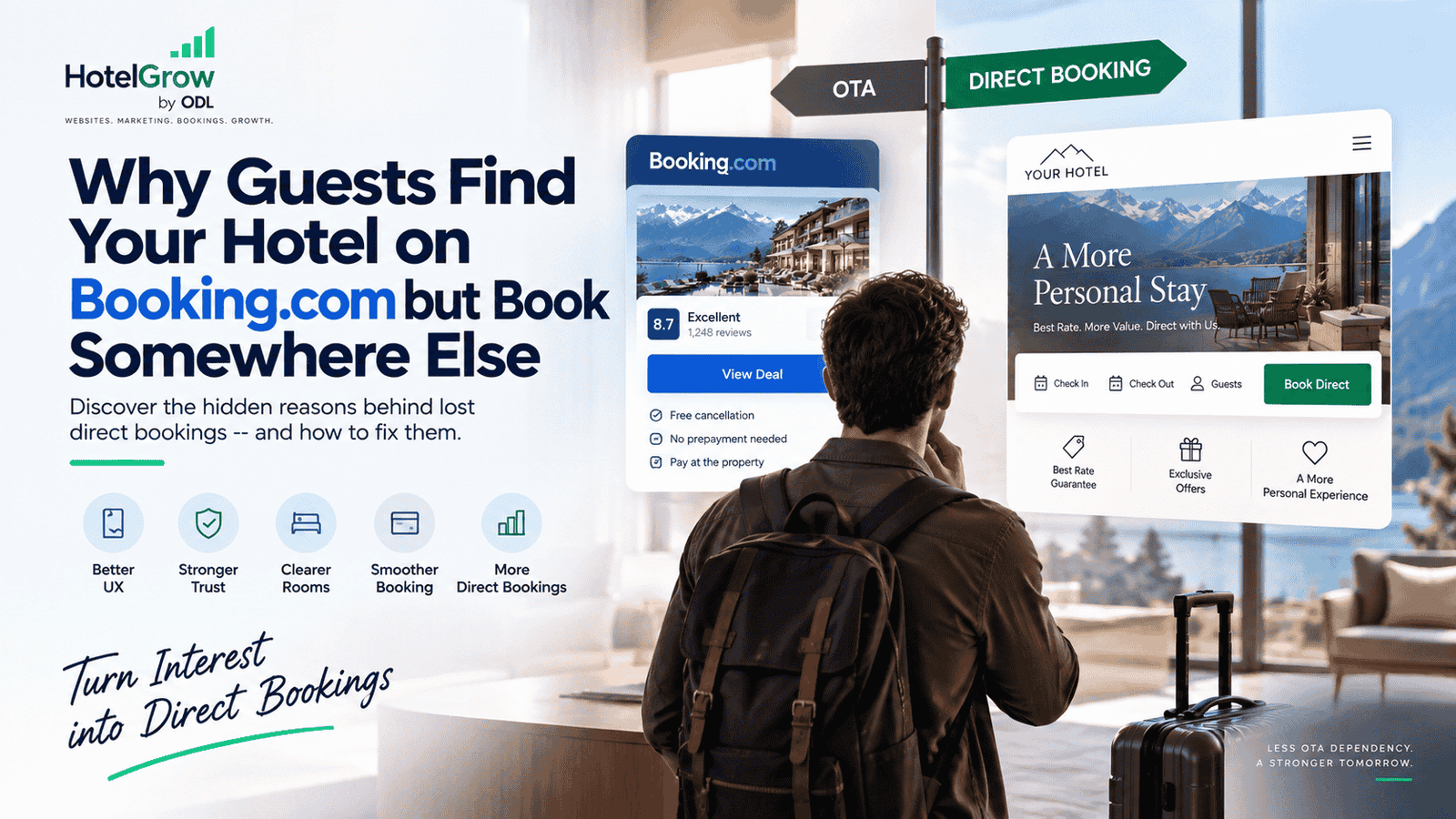
A guest can discover your hotel on Booking.com, like the property, visit your website and still book somewhere else. Often, the problem is not a lack of demand. It is friction between interest and confirmation.
A weak hotel booking funnel can lose a potential direct booking at several points: mobile usability, room presentation, trust, pricing, policies, availability or the booking engine itself. Even a small moment of uncertainty can make another hotel or a familiar OTA feel easier.
For independent hotels, improving direct bookings therefore starts by understanding the complete journey from discovery to reservation.
Why Hotel Guests Abandon the Direct Booking Journey
A traveller rarely moves directly from discovering a hotel to booking it.
The journey may look more like this:
Discovery → Research → Website Visit → Trust → Room Comparison → Price Check → Availability → Booking → Payment
Booking.com may introduce the guest to your property, but the guest can then search your hotel name, visit your website, compare rates and evaluate whether booking directly feels safe and worthwhile.
If your website creates friction at any of these stages, the guest may return to an OTA or choose another property.
That is why a hotel direct booking strategy needs to consider conversion as well as traffic generation.
Your Mobile Hotel Website Is Slow or Confusing
A hotel website may look impressive on a large screen but become difficult to use on a phone.
Test your website as if you were a first-time guest. Can you understand the hotel, find rooms, check availability and reach the booking engine without zooming, searching or navigating through unnecessary pages?
Pay particular attention to page speed, navigation, booking-button visibility and how room information appears on smaller screens.
A mobile visitor with strong booking intent should have an obvious next step.
Guests Do Not See Enough Reasons to Trust the Website
OTAs have familiar booking interfaces and clearly structured reservation information. Your direct channel needs to create enough confidence for a guest to complete the transaction there instead.
Trust can weaken when important information is difficult to find or inconsistent.
Your website should clearly communicate who you are, what guests are booking, important policies, contact information and what happens after the reservation.
Professional design helps, but clarity creates confidence.
Rooms and Rates Are Difficult to Compare
Guests should not have to work hard to understand the difference between room categories.
If room names are unclear, important features are buried in paragraphs or photographs do not clearly represent each category, comparison becomes difficult.
The same applies to rates. Guests should understand what is included, how one rate differs from another and which option suits their stay.
Good hotel website UX reduces the mental effort required to make a booking decision.
Your Direct Price or Value Is Not Clear
A guest who leaves Booking.com and visits your website will often want to know whether there is a reason to book directly.
That reason does not always have to be a lower price.
Direct value can also come from relevant benefits such as flexible conditions, breakfast, parking, a package or another property-specific advantage.
Whatever your direct-booking proposition is, make it easy to understand.
If the guest cannot quickly see the value of booking directly, returning to the familiar OTA journey may feel easier.
Cancellation and Payment Information Creates Uncertainty
A guest can be ready to book and still stop because the cancellation or payment terms are unclear.
Important conditions should be understandable before the final confirmation stage.
Avoid making guests search multiple pages to answer basic questions about cancellation, prepayment or booking conditions.
The objective is not to overwhelm the visitor with policy text. It is to remove uncertainty at the point where uncertainty can stop a reservation.
Your Photography Is Not Helping Guests Choose
Hotel photography is part of the sales process.
Guests want to understand what the room actually looks like, how much space it offers, what the bathroom is like and what distinguishes one category from another.
Strong room merchandising combines useful photography with concise information about the experience and important room features.
Beautiful destination photography can attract attention, but guests also need enough visual information to confidently choose what they are paying for.
Your Booking Engine Creates Too Much Friction
A strong hotel website can still lose bookings if the booking engine creates a poor experience.
Check how many steps it takes to move from checking availability to receiving confirmation.
Look for unnecessary friction such as repeated information, confusing rate displays, difficult date selection, unclear buttons or poor mobile usability.
The transition from your hotel website into the booking engine should also feel consistent and trustworthy.
A hotel website and booking solution should treat the website and booking engine as one customer journey rather than two separate systems.
Guests Cannot Use Their Preferred Language, Currency or Payment Method
International hotels may attract visitors from multiple feeder markets.
If important booking information is difficult to understand, prices are presented unexpectedly or an appropriate payment option is unavailable, some guests may hesitate before completing the reservation.
Review your major feeder markets and compare their needs with what your booking journey currently supports.
The objective is not necessarily to provide every possible option. It is to remove avoidable friction for the audiences that matter most to your hotel.
Your Website Does Not Reassure Guests About the Location
A traveller is not only choosing a room. They are choosing where they will stay within a destination.
Your website should make the property's location easy to understand.
Explain relevant proximity to attractions, transport, restaurants, business districts, ski areas, hiking routes or other reasons guests visit your destination.
Useful destination information can support both booking confidence and hotel SEO visibility by answering questions travellers are already researching.
You Do Not Reconnect With Visitors Who Leave
Not every visitor who abandons the booking journey is lost permanently.
Travellers often compare several properties before making a final decision. Where applicable, remarketing can help your hotel reconnect with people who previously visited important pages or demonstrated booking intent.
The objective is to remain visible during the decision process rather than continuously spending the entire marketing budget on acquiring new visitors.
Direct-booking growth therefore involves both conversion and demand recovery.
Test Your Hotel Booking Journey End to End
Do not evaluate your booking experience only from an office computer.
Open your hotel website on a mobile phone and behave like a first-time guest.
- Search for your hotel on Google.
- Open the hotel website.
- Find a suitable room.
- Compare room categories.
- Check the direct-booking value.
- Find cancellation and payment information.
- Select dates.
- Enter the booking engine.
- Continue through the reservation process.
- Record every moment that feels slow, unclear or unnecessary.
Then repeat the journey for your most important guest markets where relevant.
A single confusing step may not look serious internally, but several small points of friction can create a difficult booking experience.
Give Your Hotel a Booking Friction Score
After testing the journey, score these five areas from 1 to 5, where 5 means the experience is clear and easy:
Mobile experience: Is the journey fast and simple on a phone?
Trust: Does the website give enough confidence to book directly?
Room and rate clarity: Can guests easily understand and compare their choices?
Booking engine: Is availability-to-confirmation simple?
Direct-booking value: Is there a clear reason to complete the reservation directly?
A lower score in any area gives you a practical starting point for conversion improvement.
Improve the Booking Journey Before Buying More Traffic
If your hotel website is not converting, sending more visitors to it may not solve the underlying problem.
SEO, Google Ads, Meta campaigns and other marketing channels can generate demand, but the website and booking engine still need to convert that demand into reservations.
For independent hotels, this is why conversion rate optimization should work alongside website development, booking technology and digital marketing.
At Oxmite, our HotelGrow approach connects these areas so hotels can identify booking friction and improve the complete journey rather than treating each channel separately.
Final Takeaway
Guests finding your property on Booking.com is evidence that demand may already exist. The next challenge is giving them enough clarity, trust and convenience to complete the reservation through your direct channel.
Test your hotel website on mobile, compare rooms and rates as a guest would, review policies and direct-booking value, and complete the entire booking-engine journey yourself.
Let ODL test your hotel's booking journey with a Free Hotel Booking Funnel Audit and identify friction before it costs another direct booking.
Request your Free Hotel Booking Funnel Audit.