
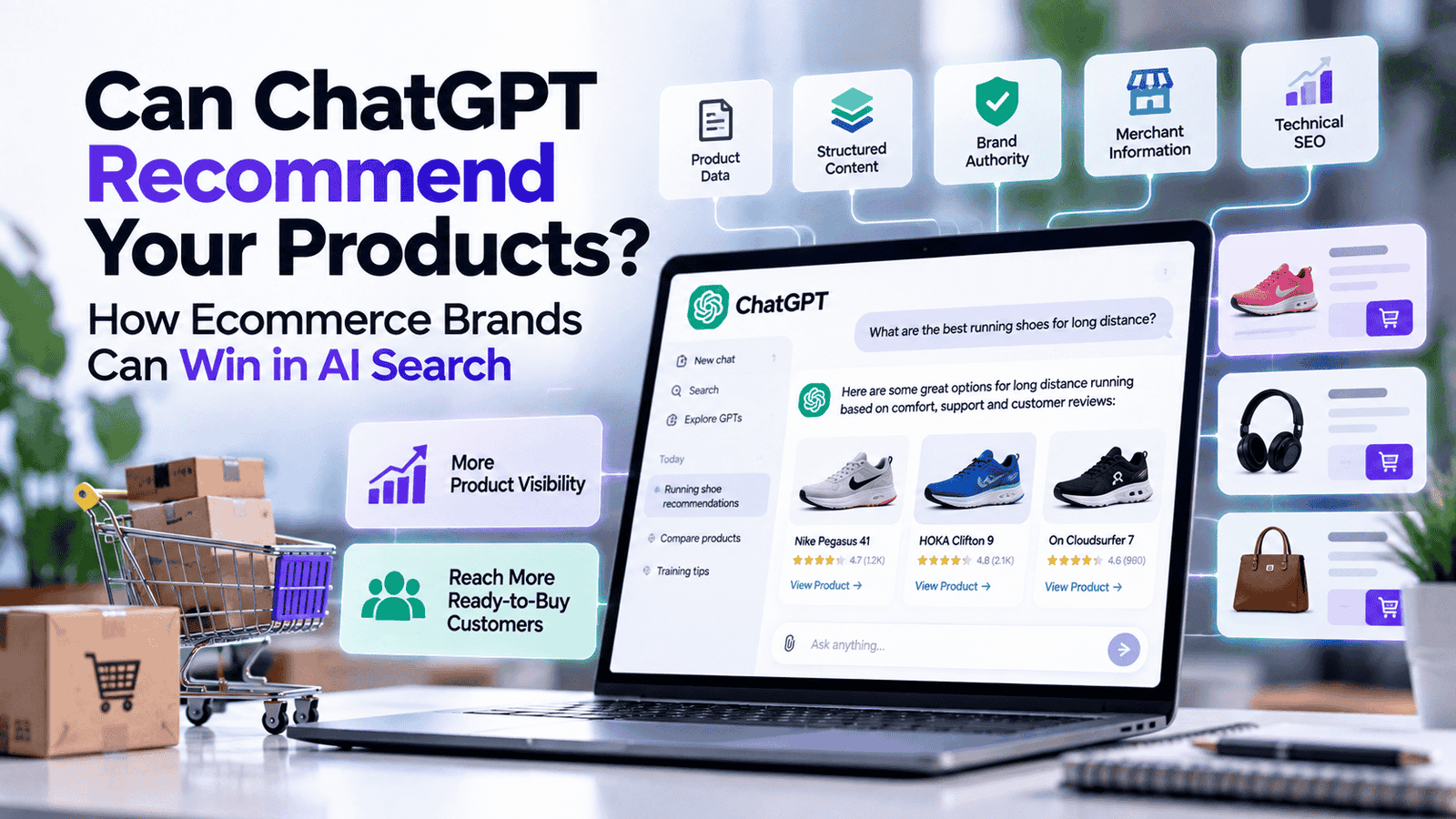
Your next ecommerce customer may not start their shopping journey on Google, Amazon or your website. They may ask ChatGPT or another AI-powered search experience to recommend the best product for a specific need.
That creates a new visibility challenge for ecommerce brands. Traditional rankings still matter, but ecommerce AI search optimization also depends on whether AI systems can accurately understand your products, attributes, availability, merchant information and relevance to the shopper's question.
The goal is not to “trick ChatGPT” into recommending your products. It is to make your ecommerce information easier for search and AI systems to discover, understand and trust.
Can ChatGPT Actually Recommend Ecommerce Products?
Yes. ChatGPT can surface product options when a conversation shows shopping intent and may display product information, imagery and links to merchants.
But appearing in these experiences is not guaranteed.
Product relevance depends on the shopper's request and the product and merchant information available to the system. This means ecommerce brands need to think beyond traditional keyword rankings.
Your products need to be machine-understandable as well as persuasive to human customers.
1. Make Your Product Data Clear and Complete
AI systems need accurate information to understand what a product is and when it may be relevant.
A product titled simply “Performance Pro X2” provides little context without additional information.
Clear product data should explain important attributes such as:
- Product type
- Brand
- Model or identifier
- Key features
- Size, color or relevant variants
- Price
- Availability
- Images
- Important specifications
The objective is not to stuff product titles with keywords. It is to remove ambiguity.
If your product information is incomplete or inconsistent, search and AI systems have less reliable information to work with.
2. Write Product Pages Around Real Buying Questions
Traditional ecommerce pages often focus heavily on short product descriptions.
AI-assisted discovery makes detailed and useful product information even more important.
A strong product page should help answer questions such as:
Who is this product for?
What problem does it solve?
What are its important specifications?
How does it differ from another model?
Is it compatible with a particular product or use case?
What is included?
What should a customer know before buying?
These are also the types of questions shoppers may ask AI assistants.
The better your product pages answer genuine buying questions, the more useful they become for both customers and machine-driven discovery.
3. Use Product Structured Data
Structured data helps search systems understand product information in a standardized format.
For ecommerce product pages, relevant Product and Offer structured data can communicate information such as price, availability and other product details.
This does not guarantee visibility or recommendations, but it improves how clearly machines can interpret important ecommerce information.
Structured data should always match what customers can actually see on the product page.
A technically optimized ecommerce website should therefore connect visible product information, structured data and catalog information rather than treating them as separate SEO tasks.
4. Keep Price and Availability Accurate
Outdated ecommerce information creates a poor customer experience.
If an AI or search experience identifies one price but the customer reaches the store and finds another, confidence can disappear quickly.
The same applies to stock availability.
Product feeds, website information and structured data should remain as consistent and current as possible.
For ecommerce brands with large or frequently changing catalogs, this becomes a technical data-management issue as much as an SEO issue.
5. Strengthen Your Merchant Information
AI-assisted product discovery is not only about understanding the item.
The system also needs information about the merchant selling it.
Your ecommerce website should make important business information easy to find and understand, including relevant contact details, shipping information, returns, payment information and customer-service policies.
This also helps human shoppers answer an important question:
“Can I trust this company enough to buy from it?”
Strong ecommerce visibility and strong ecommerce conversion often depend on the same foundation: clear information and reduced uncertainty.
6. Build Useful Content Beyond Product Pages
Not every shopper searches for a product by name.
Someone might ask:
“What type of running shoe is suitable for wet trails?”
“Which laptop is best for video editing while travelling?”
“What skincare ingredients should I look for if I have dry skin?”
These queries happen earlier in the buying journey.
Buying guides, comparison pages, category content, FAQs and educational resources can help your brand become relevant before the customer has decided exactly what to purchase.
This is where ecommerce SEO, content marketing and AI search optimization begin to overlap.
7. Make Product Comparisons Easier to Understand
AI assistants are particularly useful when customers need to compare options.
Ecommerce brands can support this type of discovery by clearly explaining meaningful differences between products.
Instead of simply listing specifications, explain what those differences mean for the buyer.
For example:
Model A: Better suited to occasional users who prioritize affordability.
Model B: Designed for frequent users who need additional capacity or performance.
The exact language must be based on genuine product characteristics.
Useful comparison content can improve customer decision-making while giving search systems clearer context around different products.
8. Maintain Consistent Product Information Across the Web
Your product may appear across your own store, merchant feeds, marketplaces, reviews, distributors and other third-party websites.
Major inconsistencies can make product understanding more difficult.
Product names, identifiers, specifications and important attributes should be managed consistently where possible.
This becomes especially important for brands selling through several channels.
Think of product data as a business asset rather than information that exists only on individual product pages.
9. Strengthen Brand and Product Authority
Good technical data alone does not make a product the best answer to every shopping question.
AI-assisted discovery can draw on information from across the web, including publicly available product information and other relevant retail sources.
That makes broader brand authority important.
Useful editorial coverage, genuine customer discussion, product reviews, authoritative references and consistent information can help create a stronger digital footprint around the brand and its products.
Do not manufacture reviews or artificial mentions for AI visibility.
The objective is to build real authority that both customers and discovery systems can evaluate.
10. Optimize Images and Product Media
Ecommerce discovery is increasingly visual.
Use high-quality product images that clearly show the item, important details and relevant variants.
Image filenames, alt text and surrounding product information should accurately describe what is shown.
Where appropriate, additional product media can also help customers understand how the product looks, works or is used.
Better media is not only an SEO improvement. It can reduce uncertainty during the buying process.
11. Make Your Ecommerce Site Easy to Crawl
Excellent product content has limited search value if crawlers struggle to access it.
Technical ecommerce SEO should review issues such as:
- Crawlability
- Indexation
- Canonicalization
- Product variants
- Internal linking
- JavaScript rendering
- Duplicate pages
- Site performance
- Structured data
Large catalogs can create particularly complicated technical SEO problems.
A strong ecommerce AI search optimization strategy therefore starts with many of the same foundations required for conventional organic search.
12. Consider Product Feeds for AI Commerce
AI shopping is moving beyond systems simply reading public webpages.
OpenAI currently provides a product-feed framework through its Agentic Commerce infrastructure, allowing eligible merchants and partners to provide structured catalog information for ChatGPT shopping experiences.
Product feeds can communicate information such as product identifiers, descriptions, pricing, inventory and media in a structured format.
Shopify merchants also have an important advantage: OpenAI states that Shopify Catalog product data is already integrated with ChatGPT, helping eligible products appear more accurately in relevant shopping conversations.
This does not mean every Shopify product will be recommended.
Relevance to the user's request still matters.
Google Search Still Matters in an AI Search Strategy
Optimizing for ChatGPT should not mean ignoring Google.
Google also relies heavily on structured product information through Merchant Center, product feeds and Product structured data.
Its AI-powered search and shopping experiences are another reason ecommerce brands should maintain accurate, detailed and machine-readable product information.
The strongest approach is therefore not SEO versus AI search.
It is building a product-information foundation that supports traditional search, shopping platforms and emerging AI discovery experiences.
Do Not Optimize Only for the Phrase “Best Product”
AI search optimization should not become another form of keyword stuffing.
Customers ask highly specific questions.
They may search for the best product for a particular budget, use case, compatibility requirement, location, material, feature or problem.
That means detailed product attributes and useful buying content can be more valuable than repeatedly describing every item as “best.”
Your ecommerce content should help machines understand when a product is relevant and for whom.
How to Audit Your Ecommerce AI Search Visibility
Start by reviewing your store from the perspective of a system trying to understand your products.
Can it clearly determine what each product is?
Are specifications and variants complete?
Are price and availability consistent?
Is Product structured data implemented correctly?
Can important pages be crawled?
Do product pages answer genuine customer questions?
Is merchant and policy information clear?
Does useful content exist around the problems your products solve?
Are your products and brand referenced consistently outside your website?
These questions provide a more useful starting point than simply asking whether ChatGPT currently mentions your brand.
Final Takeaway
The question is no longer only whether your ecommerce products rank on Google.
Customers can now discover and compare products through search engines, shopping platforms and AI assistants such as ChatGPT.
Winning in ecommerce AI search optimization starts with the fundamentals: accurate product data, useful product pages, structured information, technical SEO, merchant transparency, strong content and genuine brand authority.
There is no legitimate way to guarantee that ChatGPT will recommend a particular product.
The opportunity is to make your products easier for AI and search systems to accurately discover, understand and evaluate when they are relevant to a customer's request.
At Oxmite, we combine ecommerce SEO, AEO/GEO, content strategy and technical optimization to help ecommerce brands build stronger visibility across traditional and AI-assisted discovery.
Can Google and AI systems properly understand your products today?
Request an AI Search Visibility Audit to identify gaps across product data, technical SEO, structured content, ecommerce pages and AI-search readiness.