When customer requests live in emails, approvals sit in spreadsheets, and teams copy information between tools, small delays quickly become expensive. Digital transformation services help businesses connect these workflows, improve visibility, and reduce avoidable manual effort. But which processes should you modernize first?
What Are Digital Transformation Services?
Digital transformation services involve redesigning how work happens using appropriate software, integrated data, automation, and employee training. They can include cloud platforms, CRM systems, custom applications, analytics, and AI-enabled workflows.
The goal is not to digitize everything. It is to make a measurable business process faster, more reliable, or easier for customers. McKinsey emphasizes that transformation involves changing how organizations operate, not simply installing technology.
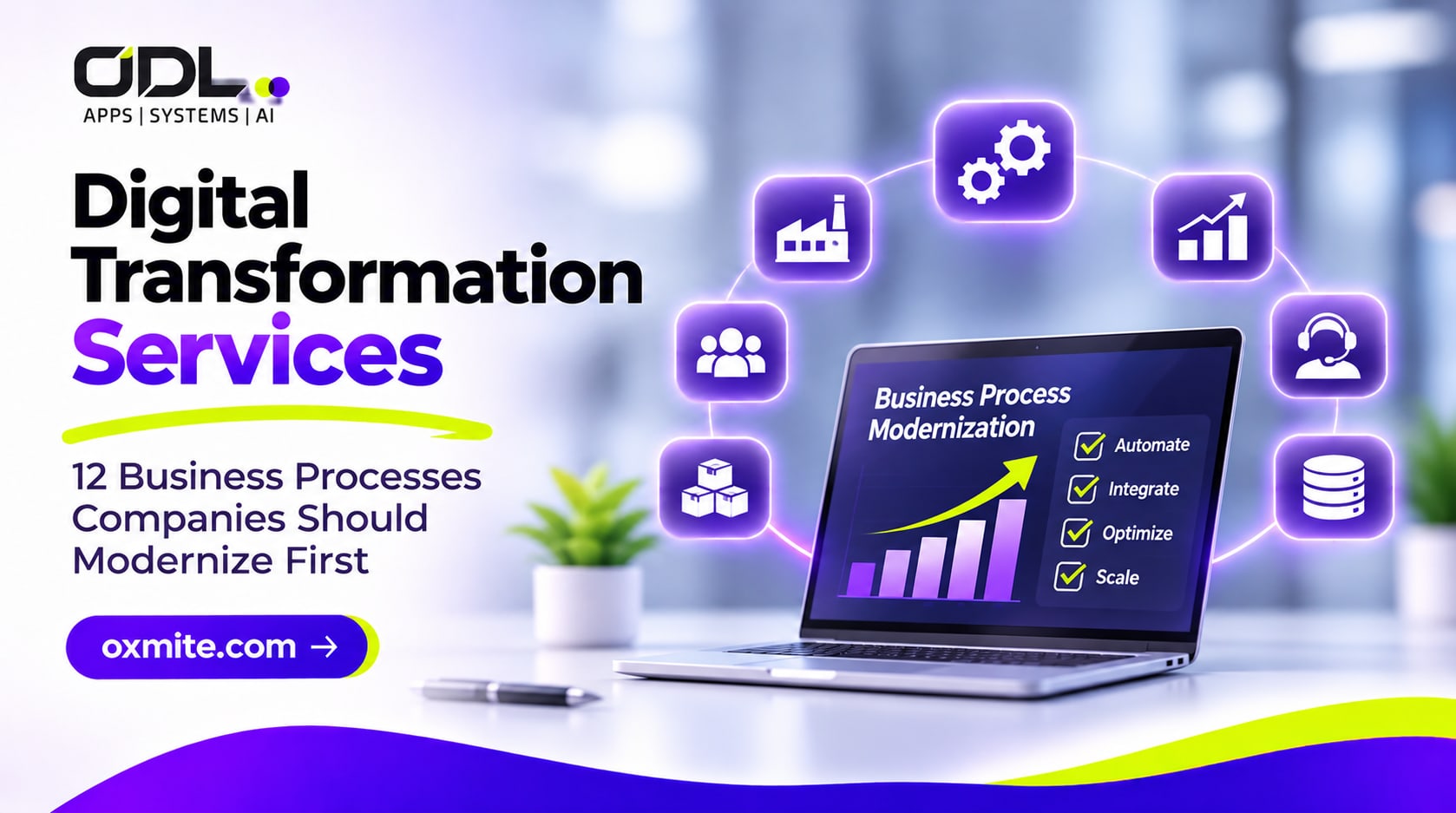
12 Business Processes Companies Should Modernize First
1. Customer support
Connect your knowledge base, ticketing system, and support channels. Assistants can handle routine questions while sensitive complaints reach a person. Track resolution time and customer satisfaction.
2. Sales and CRM
Replace scattered lead spreadsheets with a shared pipeline, automated reminders, and consistent handoffs. Measure lead response time and qualified opportunities, not just contacts collected.
3. Finance and invoicing
Digitize invoice capture, matching, approvals, and exception reviews. Keep payment authorization controlled. Track processing time, errors, and overdue approvals.
4. HR and onboarding
Use secure digital forms, onboarding checklists, and role-based access. New employees should know what comes next without chasing multiple departments. Measure time to productivity.
5. Inventory management
Connect sales, purchasing, and stock records to reduce guesswork. Automatic low-stock alerts support faster decisions. Monitor stockouts and inventory accuracy.
6. Procurement
Standardize purchase requests, supplier records, and approval steps. Give teams visibility into pending orders and exceptions. Track purchase cycle time.
7. Marketing operations
Link campaign forms, consent records, CRM activity, and follow-up workflows. Evaluate qualified leads and conversion rates rather than sending more messages automatically.
8. Reporting and analytics
Replace repetitive report preparation with dashboards pulling from governed data sources. Define who owns each metric. Track reporting hours and decision delays.
9. Document management
Introduce searchable files, version control, permissions, and approval histories. This reduces time lost finding the correct contract or policy. Measure retrieval time.
10. Project and task management
Use shared ownership, deadlines, and workflow status instead of disconnected updates. Track overdue tasks and on-time delivery.
11. Booking and scheduling
Enable online reservations, real-time availability, and reminders where suitable. Keep staff able to resolve exceptions. Monitor booking completion and no-shows.
12. IT support and maintenance
Centralize incident requests, automate routine categorization, and alert technicians to recurring failures. Track mean time to resolution and repeated incidents.
These are candidates, not a universal ranking. Priorities depend on each company's workload, data quality, customer impact, and risk. A hospital may prioritize secure appointment coordination, while a manufacturer might begin with purchasing and inventory records. Both need clear ownership, access controls, and staff input before any automation goes live.
How to Prioritize Digital Transformation Solutions
Score each workflow from one to five on business impact and readiness; separately rate implementation difficulty. A simple illustrative priority score is:
Impact + Readiness + (6 − Difficulty)
Higher scores suggest promising pilots, not guaranteed returns.
Before investing, document a baseline KPI and confirm whether existing software can solve the problem. Test a limited pilot with actual users, including exception cases. Review staff adoption and the ongoing cost of maintaining integrations before expanding.
For specialized integrations, custom software may make sense.
IBM reported that Volumetric Building Companies cut operational cycle times by 50% across purchasing, manufacturing, and inventory after an SAP Cloud ERP transformation. That company-specific result is not a universal benchmark.
Start With Oxmite Digital Ltd
Oxmite Digital Ltd provides workflow automation, custom AI software, and consulting to assess practical opportunities.
Share your most frustrating process and existing systems through its contact page to discuss a focused modernization roadmap.
Related reading: Digital Transformation Consulting: Benefits, Costs and How to Choose the Right Consulting Partner