A modern clinic can generate plenty of online visibility and still lose patients between the first Google search and the final appointment.
A successful clinic patient acquisition system connects every stage of that journey: local search visibility, website conversion, enquiry handling, appointment booking, reminders, follow-up, reviews and patient reactivation.
The objective is not simply to generate more traffic. It is to create a connected system that turns more qualified patient demand into booked appointments while reducing unnecessary administrative work.
The Patient Journey Should Work as One Connected System
Many clinics already have the individual pieces: a website, Google Business Profile, telephone number, booking software and patient database.
The problem is that these tools often operate separately.
A potential patient might discover the clinic on Google, visit the website, call reception, receive no answer and leave without booking.
A stronger system connects the journey:
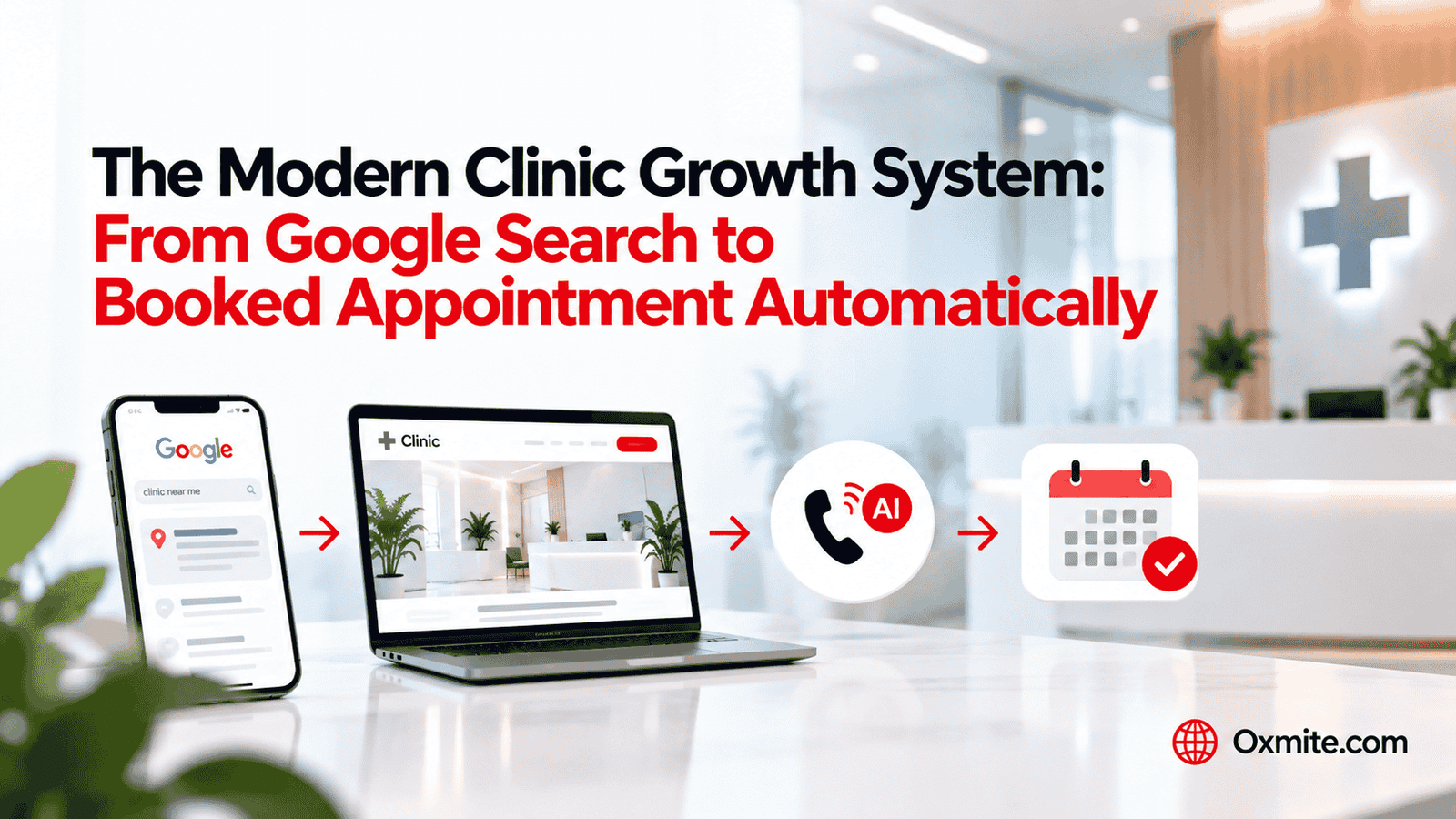
Google Search → Clinic Website → Enquiry → Appointment Booking → Reminder → Visit → Review Request → Reactivation
Every stage should make it easier for the patient to take the next appropriate action.
Step 1: Get Found When Patients Search on Google
Patient acquisition often begins before someone knows the clinic's name.
Potential patients may search for a clinic, treatment or healthcare service in their local area.
A strong local SEO strategy helps the clinic become more visible for relevant searches by improving its website, location information, service content and Google Business Profile.
The goal is not traffic for its own sake.
The goal is to attract people who are actively looking for services the clinic genuinely provides.
Step 2: Turn the Clinic Website Into a Patient Acquisition Channel
Getting someone onto the website is only the beginning.
The website must quickly answer the questions that influence whether a potential patient takes the next step.
Patients should be able to understand what the clinic offers, where it is located, how to contact it and how to request or book an appointment.
Important service information, practitioner information where appropriate, opening hours, location details and clear appointment actions should be easy to find.
A confusing website creates friction between search intent and appointment intent.
A conversion-focused clinic website and digital growth system is designed around reducing that friction.
Step 3: Capture Enquiries Even When Reception Is Busy
A clinic cannot assume that every potential patient will submit a form or call again later.
If someone calls while reception is busy or outside normal hours, that enquiry may disappear.
An AI voice receptionist can provide an additional administrative call-handling layer for suitable workflows.
It can potentially answer approved routine questions, capture caller information, identify the purpose of the call and route appropriate appointment enquiries into the next stage.
Complex, sensitive or clinically appropriate conversations should have clear pathways to human staff.
The purpose of AI is not to replace the patient relationship. It is to prevent routine enquiries from being lost because staff capacity is limited.
Step 4: Move Enquiries Toward Appointment Booking
Capturing an enquiry without creating a clear next step still leaves friction in the patient journey.
Where compatible systems and clinic policies allow, appointment automation can connect enquiries with scheduling.
A patient may be able to request an available appointment without waiting for repeated calls between reception and the patient.
The exact workflow depends on the clinic's scheduling software, services, appointment rules and integrations.
The business outcome is straightforward: shorten the distance between “I need an appointment” and “My appointment is booked.”
Step 5: Reduce Missed Appointments With Automated Reminders
Patient acquisition does not finish when an appointment enters the calendar.
The appointment still needs to happen.
Automated confirmations and reminders can help maintain communication between booking and attendance.
Depending on the clinic's systems and communication policies, workflows may include booking confirmation, appointment reminders and instructions relevant to the scheduled visit.
Automation can also reduce repetitive administrative communication for reception teams.
Step 6: Connect Patient Enquiries With a CRM or Follow-Up System
Not every enquiry immediately becomes an appointment.
Some potential patients may request information, need to consider availability or require an appropriate follow-up from staff.
Without a structured system, those enquiries can become scattered across telephone notes, inboxes, forms and individual employees.
A CRM or suitable patient enquiry management workflow can help the clinic track appropriate non-clinical acquisition information and follow-up activity.
Any healthcare implementation should be designed around applicable privacy, security and data-handling requirements rather than moving sensitive information into general-purpose tools without proper assessment.
Step 7: Build a Consistent Review Request Process
Reviews can influence how potential patients evaluate a clinic when comparing local options.
Instead of relying entirely on staff remembering to request feedback manually, clinics can create an appropriate post-visit process.
Where suitable and compliant, a workflow can invite patients to provide genuine feedback after their visit.
The objective should be to encourage authentic feedback rather than manipulate ratings or selectively manufacture positive reviews.
Over time, a consistent review process can strengthen the clinic's online reputation and provide useful feedback about the patient experience.
Step 8: Reactivate Existing Patients Appropriately
Growth does not always need to come entirely from new patient acquisition.
Depending on the clinic, its services, patient consent and applicable communication requirements, there may be legitimate opportunities to reconnect with existing patients.
Appropriate recall or reactivation workflows can help clinics manage follow-up communication that would otherwise depend on employees manually reviewing records.
The exact process should reflect the type of clinic, the nature of the service and relevant healthcare communication requirements.
Step 9: Measure the Complete Patient Acquisition Journey
Marketing performance should not stop at website traffic or advertising clicks.
A clinic should understand what happens after the enquiry arrives.
The useful questions are:
Which channels generate qualified enquiries?
How many enquiries become appointments?
Where are potential patients abandoning the journey?
How many calls are going unanswered?
Which marketing activities contribute to booked appointments?
Connecting marketing, enquiry and booking data gives management a clearer view of the patient acquisition process.
That makes it easier to identify whether the next investment should go into visibility, website conversion, call handling, booking automation or another part of the journey.
Automation Should Support the Clinic Team, Not Replace It
The strongest clinic automation strategy does not attempt to automate every patient interaction.
Clinical questions, sensitive situations, unusual requests and conversations requiring professional judgement should remain with appropriate people.
Automation is most valuable when it handles suitable repetitive administrative work and moves information between systems more efficiently.
That can give reception and clinic teams more capacity for patients who genuinely need human assistance.
Build a Clinic Patient Acquisition System
A clinic does not necessarily need more disconnected marketing tools.
It needs a connected clinic patient acquisition system that helps qualified patients move from discovery to appointment with less friction.
Local SEO creates visibility. The website builds confidence. AI call handling can capture suitable enquiries. Booking automation helps turn intent into appointments. Reminders support attendance. CRM workflows organize appropriate follow-up. Review and reactivation processes help strengthen the longer-term patient relationship.
At Oxmite, we can bring these components together through clinic websites, local SEO, AI agents, appointment automation, integrations and CRM workflows.
The goal is not simply more traffic. It is a more efficient journey from patient search to booked appointment.
Design a Patient Acquisition System around your clinic's existing website, booking process, reception workflow and growth objectives.