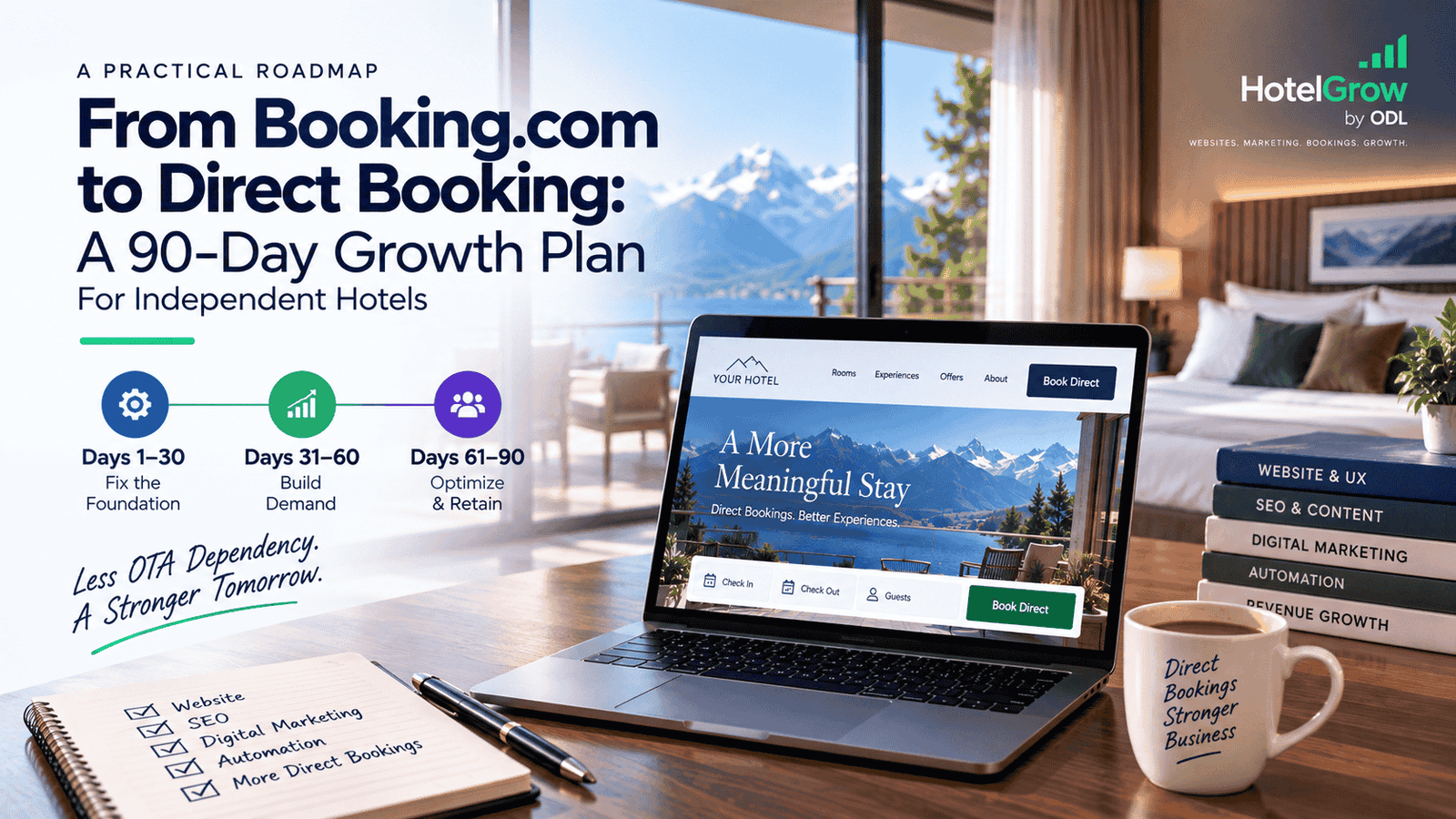
Reducing OTA dependency is not a one-week website project. It is a sequence: fix the booking foundation, build qualified demand, then optimize what converts.
A practical hotel direct booking plan should improve how your website, booking engine, search visibility, advertising and guest communication work together. Booking.com and other OTAs can remain useful distribution channels, but your hotel should also build an owned channel that gives you more control over acquisition costs, guest relationships and direct revenue.
Days 1–30: Fix the Direct Booking Foundation
Start by auditing the complete journey from website visit to confirmed reservation. Review your website, mobile experience, booking engine, analytics, conversion tracking and current direct-versus-OTA booking mix.
Your booking call to action should be easy to find, rooms should be clearly presented and guests should be able to reach the booking engine without unnecessary steps. Pay particular attention to mobile because a difficult mobile booking journey can reduce the value of the traffic you already generate.
This is also the time to confirm that your booking engine, PMS and channel manager are working together correctly. Rates, availability and reservations should move through the system reliably before you invest heavily in generating additional demand.
A complete hotel direct booking strategy should therefore start with the booking foundation rather than advertising alone.
Days 31–60: Build Qualified Search Demand
Once the booking journey is ready, focus on bringing relevant travellers to your website.
Start with priority hotel SEO and destination pages around searches that can lead to bookings. Instead of publishing generic content, create useful pages around your destination, local attractions, seasonal travel, experiences and the types of stays your target guests actually search for.
Your Google Business Profile and other important hotel information should also be accurate and consistent. Strong local visibility helps potential guests discover the property and verify important information before visiting your website.
The goal is not simply more traffic. It is more qualified demand that has a realistic opportunity to become a direct reservation.
Days 31–60: Launch Digital Marketing and Remarketing
With analytics and the booking journey in place, you can begin using paid marketing more strategically.
Google campaigns can capture travellers already searching for relevant accommodation, while Meta campaigns can support discovery, offers and remarketing. Visitors who viewed rooms, checked offers or reached the booking journey without completing a reservation can become useful remarketing audiences where applicable.
Measure these campaigns against booking activity rather than impressions and clicks alone. The important questions are how many qualified visitors reached the booking engine, how many converted and what it cost to acquire those reservations.
Hotel digital marketing works best when advertising, website conversion and booking technology are measured as parts of the same system.
Days 31–60: Prepare for Google and AI Search Visibility
Hotel discovery is no longer limited to traditional search results. Travellers can use search engines and AI-powered tools to research destinations, compare options and answer travel-planning questions.
Create clear content about your rooms, amenities, location, destination, experiences and common guest questions. Useful and well-structured information supports traditional SEO while also making your hotel easier for AI-powered systems to understand.
This should be treated as part of the hotel's broader visibility strategy rather than a separate marketing experiment.
Need Help Coordinating the Full Implementation?
By the midpoint of the plan, you may be managing website improvements, booking technology, SEO, content, Google visibility, advertising, analytics and remarketing at the same time.
Don't want to coordinate the website, booking engine, SEO, ads and automation internally?
Oxmite's HotelGrow solution brings these areas together into one coordinated hotel growth system focused on strengthening the direct-booking channel.
Days 61–90: Find Where Potential Bookings Are Being Lost
By the third phase, you should have enough performance data to identify weaknesses in the booking funnel.
Look at the journey from website visitor to room-page visitor, booking-engine visitor, availability search and completed reservation. A large drop between two stages can reveal where potential bookings are being lost.
The problem could be mobile usability, confusing room information, weak calls to action, booking-engine friction, an unattractive offer or poorly targeted traffic. Use the data to decide what should be improved first rather than redesigning everything at once.
Days 61–90: Optimize Offers and Campaign Performance
Use what you learned during the first two months to improve high-impact pages, direct-booking offers and advertising campaigns.
Refine room-page content, booking calls to action, landing pages, campaign targeting and remarketing audiences based on actual performance. If certain destination pages attract qualified visitors but produce little booking activity, examine whether the page creates a clear path toward rooms and availability.
Optimization should connect marketing activity to commercial outcomes: conversion, acquisition cost, direct revenue and retained revenue.
Days 61–90: Automate Follow-Up and Repeat Bookings
Direct booking becomes more valuable when the relationship continues after the first reservation.
Where your technology and applicable privacy requirements allow, automation can support booking confirmations, pre-arrival communication, relevant upsells, post-stay follow-up and repeat-booking campaigns.
Previous guests already know your property. Building an owned relationship with them can create future direct-booking opportunities without requiring your hotel to repeatedly reacquire the same guest through a third-party platform.
Your 90-Day Hotel Direct Booking Plan
The complete implementation can be kept simple:
- Days 1–30: Audit and improve the website, booking funnel, mobile UX, analytics, booking engine and hotel-system integrations.
- Days 31–60: Build SEO and destination visibility, strengthen Google presence, launch targeted advertising and establish remarketing and AI-search foundations.
- Days 61–90: Analyze conversion data, improve pages and offers, optimize campaigns, automate guest communication and strengthen repeat bookings.
The sequence matters. Sending more traffic to a weak booking journey can waste marketing spend, while improving a website without generating qualified demand limits its commercial potential.
Measure Booking Mix, Acquisition Cost and Direct Revenue
At the end of 90 days, do not judge success by website traffic alone.
Compare direct-booking contribution, OTA contribution, website conversion, booking-engine performance, customer acquisition cost and revenue generated by your marketing channels. Where reliable data is available, compare the cost and retained value of different booking sources.
The objective is not simply to say that direct bookings increased. The more useful question is whether your hotel's booking mix is becoming more commercially efficient.
What Should Continue After Day 90?
Day 90 is not the end of your hotel digital marketing plan. It is the point where you should have a stronger foundation and enough data to make better decisions.
Continue improving SEO, destination content, website conversion, advertising efficiency, remarketing, direct offers, guest communication and repeat-booking campaigns. Your direct channel should evolve according to real search, marketing and reservation data.
Get a Custom 90-Day Direct Booking Growth Plan
A successful hotel direct booking plan requires more than redesigning a website or launching advertisements. Website technology, booking systems, SEO, digital marketing, analytics and guest retention need to work toward the same commercial objective.
Booking.com and other OTAs can remain part of your distribution strategy. The goal is to build a stronger direct channel alongside them and gradually create more control over your booking mix.
Oxmite helps independent hotels connect website development, booking technology, SEO, digital marketing, automation and AI-search visibility through its HotelGrow approach.
Get a Custom 90-Day Direct Booking Growth Plan for Your Hotel and identify what your property should prioritize first, second and third.
Final Takeaway
Moving from heavy OTA dependency toward more direct bookings requires a sequence, not a single tactic. Fix your booking foundation during the first 30 days, build qualified demand during days 31–60 and use conversion data, remarketing and automation to improve performance during days 61–90.
A coordinated hotel direct booking plan gives your hotel a clearer path toward a healthier channel mix, stronger guest relationships and more control over how bookings are acquired.